
Published on the EuroHub Asia Blog
Trade between Europe and Asia used to be slow. Ships took months. Paperwork took weeks. Businesses lost time and money at every border.
That is changing fast. And one city sits right at the center of the change: Dubai.
In this article, we break down the real numbers behind Dubai’s rise as a global trade hub. We will show you why so many European and Asian businesses now route their trade through the UAE. And we will show you how your business can use this bridge too.
A Trade Hub Growing Faster Than Almost Anywhere Else
Let’s start with the headline number.
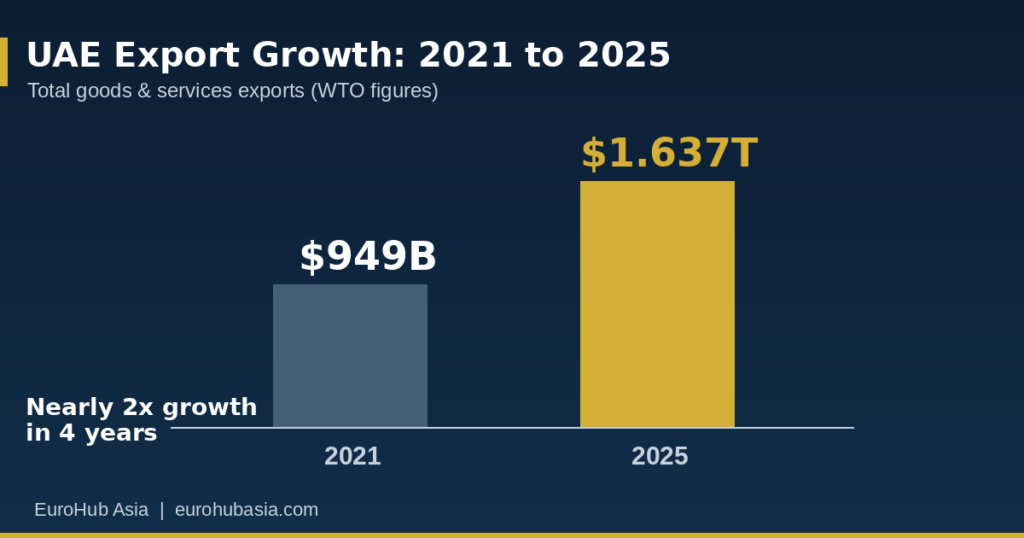
In 2021, the UAE’s total exports were worth $949 billion. By 2025, that number had climbed to $1.637 trillion. That is according to World Trade Organization (WTO) figures reported by Gulf News.
Read that again. The UAE almost doubled its export value in just four years.
This growth pushed the UAE into the top 10 global exporters in the world. It now ranks 9th in goods exports and 13th in goods imports. That puts a small country with under 10 million people ahead of many far larger economies.
Goods exports alone reached $1.33 trillion, making up 53% of the UAE’s total goods trade. Services exports added another Dh1.14 trillion, or 61.4% of the services trade total.
The UAE’s trade surplus also grew. It reached Dh584.1 billion in 2025, up from Dh492.3 billion in 2024. That is a 19% jump in a single year.
And the UAE has not just grown fast. It has led the region for over a decade. It has held the position of the top trading nation in the Middle East and Africa every year since 2014.
Why Dubai, Specifically?
The UAE’s national numbers are impressive. But Dubai itself tells an even more focused story.
Dubai Chamber of Commerce reported that its member companies’ exports and re-exports reached AED 86 billion in the first quarter of 2025 alone. That is a 16.8% increase compared to the same period the year before.
To put that in perspective, AED 86 billion in just three months means Dubai’s private sector is trading at a pace of well over AED 340 billion a year, and growing.
Behind every one of those shipments is paperwork. In that same quarter, Dubai Chamber issued 204,240 Certificates of Origin. This is the document that proves where a product was made. It is required for customs clearance almost everywhere in the world. The number of certificates issued grew 7% year over year, showing just how much trade activity is flowing through the emirate.
Where does this trade go? GCC countries (Saudi Arabia, Qatar, Kuwait, Bahrain, and Oman) account for 48.2% of Dubai Chamber members’ exports and re-exports. That means Dubai is not just a destination. It is a launchpad. Goods arrive in Dubai from Europe and Asia, and Dubai businesses send them onward across the wider Gulf region and beyond.
The “Re-Export” Model: Dubai’s Secret Weapon
Here is the part most people miss.
A huge share of Dubai’s trade is re-export. That means goods are imported into Dubai, then exported again to a third country, sometimes with light processing, packaging, or consolidation in between.
Why does this matter for a European or Asian business?
Because it means Dubai is not a competitor market you have to fight for. It is a connector. A European manufacturer can ship one large container to Dubai instead of many small shipments to different Asian countries. From there, Dubai’s logistics network, free zones, and trade infrastructure take over. The same works in reverse for Asian manufacturers wanting to reach Europe, Africa, and the wider Middle East.
This is exactly why Dubai has built:
- World-class ports (Jebel Ali is one of the busiest in the world)
- Major international airports for air freight
- Over 30 free zones offering 100% foreign ownership and tax benefits
- A time zone that overlaps with both European morning hours and Asian afternoon hours
Few cities in the world can say all of that. Dubai can.
What This Means for Your Business
If you are a European business trying to reach Vietnam, India, Thailand, or Indonesia, going through Dubai often means:
- Fewer direct shipping routes to arrange
- Access to trade finance and Islamic banking options
- A stable, business-friendly legal environment
- A single hub to manage multiple Asian destinations
If you are an Asian business trying to reach European markets, the same logic applies in reverse. Dubai gives you one strong foothold instead of ten weak ones.
This is the entire idea behind EuroHub Asia. We do not just talk about trade between Europe and Asia. We help you use Dubai the way the data shows it is already being used: as the busiest, fastest-growing connection point between the two continents.
Understanding Dubai’s Free Zones
A big part of Dubai’s trade success comes from its free zones. There are over 30 of them across the emirate, and each one is built for a specific type of business.
A few of the most relevant ones for trade businesses:
- Jebel Ali Free Zone (JAFZA): Built right next to Jebel Ali Port, one of the busiest container ports in the world. Ideal for businesses moving physical goods in bulk.
- Dubai Airport Free Zone (DAFZA): Located at Dubai International Airport. Built for businesses that rely on air freight and fast-moving goods.
- Dubai Multi Commodities Centre (DMCC): Focused on commodities trading, from gold to agricultural products.
- Dubai International Financial Centre (DIFC): Built for finance, banking, and trade-related professional services.
Each of these zones offers 100% foreign ownership, 0% personal income tax, and streamlined company setup. For a European or Asian business new to the region, choosing the right free zone can be the difference between a smooth setup and months of unnecessary paperwork.
A Real-World Example
Picture a mid-sized German machinery manufacturer. For years, it shipped directly from Hamburg to individual buyers in Vietnam and Indonesia. Each shipment meant separate paperwork, separate freight contracts, and separate customs processes.
By routing shipments through a Dubai free zone instead, the company could consolidate multiple orders into fewer, larger shipments. It could store inventory locally in the UAE and dispatch smaller batches quickly across Southeast Asia as orders came in. Paperwork dropped. Delivery times to individual Asian buyers improved. And the company gained a Gulf region presence as a side benefit, opening up sales it was not even looking for originally.
This is not a rare story. It is the exact pattern behind Dubai’s re-export numbers we covered earlier in this article.
Frequently Asked Questions
Does my business need a physical office in Dubai to use it as a trade hub?
Not always. Many free zones allow flexi-desk or virtual office setups for trading companies, especially in the early stages. A physical warehouse becomes more relevant once your shipment volume grows.
Is Dubai only useful for large companies?
No. Small and medium businesses often benefit the most, since they cannot easily justify separate logistics setups in every Asian market on their own. Dubai lets them centralize.
How long does it take to set up a trading company in a Dubai free zone?
With the right guidance, many free zone company setups can be completed in a matter of weeks, not months.
What are the most common mistakes businesses make when entering the UAE market?
Three mistakes come up again and again. First, choosing the wrong free zone for their specific business activity, which creates licensing headaches later. Second, underestimating how much local market knowledge matters, even in a business-friendly environment. Third, treating Dubai purely as a tax benefit rather than as the logistics and connectivity advantage the data in this article actually points to. Businesses that avoid these three mistakes tend to see results far faster than those who do not.
Is now really a good time to enter, given how much the UAE has already grown?
Based on the growth trajectory in this article, the answer is yes. A market growing from $949 billion to $1.637 trillion in exports over four years is not a market that has already peaked. It is one still actively building the infrastructure and trade relationships that will define the next decade of Europe-Asia commerce.
The Bottom Line
The numbers are clear. UAE exports nearly doubled in four years. Dubai’s private companies are trading at over AED 340 billion a year. Nearly half of that trade flows onward into the wider Gulf region.
Dubai is not just “a” trade hub. Based on current growth rates, it is becoming the trade hub for anyone connecting Europe and Asia.
The only question left is whether your business is using this bridge yet, or still shipping the long, slow, expensive way.
Want to know exactly how Dubai’s trade network can work for your business? Request a free consultation with EuroHub Asia, and we will map out the fastest route for your goods, your market, and your budget.
Data sources: World Trade Organization (WTO) export figures as reported by Gulf News; Dubai Chamber of Commerce Q1 2025 trade report.
Get Trade & Logistics Insights in your inbox
Subscribe to our newsletter for the latest updates on Europe-Asia trade, logistics, and business insights