
Published on the EuroHub Asia Blog
“Should I ship by sea or by air?”
Almost every business asks this question at some point. And almost every business gets it wrong at least once.
Choose air freight for the wrong shipment, and you burn your profit margin on shipping costs. Choose sea freight for the wrong shipment, and you miss your delivery deadline, or worse, lose the customer.
In this article, we break down the real cost and time numbers so you can make this decision with data instead of guesswork.
The Cost Numbers: How Big Is the Gap?
Let’s start with cost, because this is usually the first question every business asks.
Based on current global freight industry benchmarks:
Air Freight:
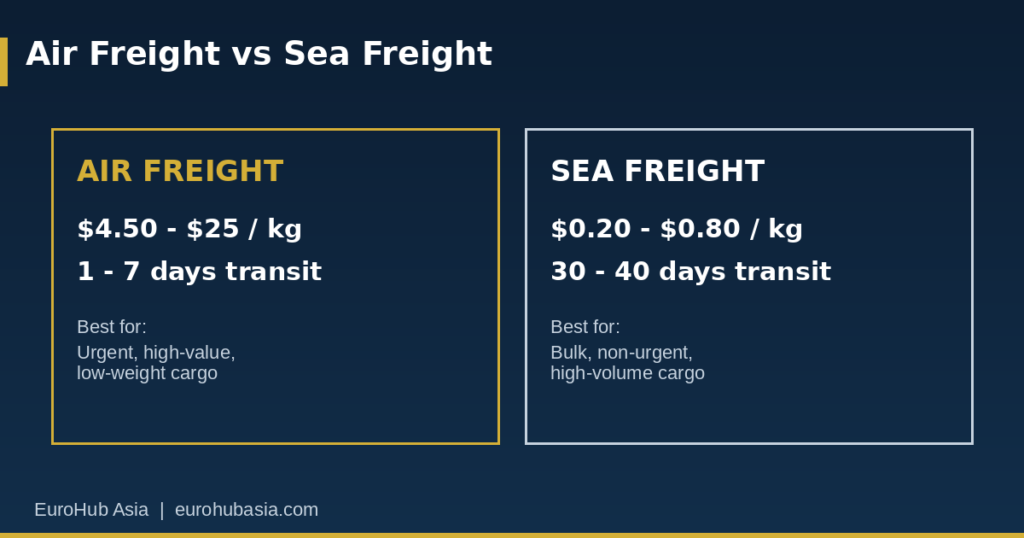
| Service Level | Cost per kg | Typical Transit Time |
|---|---|---|
| Standard air freight | $4.50 – $7.50 | 5–7 days |
| Express air freight | $7.00 – $12.00 | 2–3 days |
| Charter air freight | $12.00 – $25.00 | 1–2 days |
Ocean (Sea) Freight:
| Service Level | Cost per kg | Typical Transit Time |
|---|---|---|
| FCL (Full Container Load) | $0.20 – $0.50 | 30–40 days |
| LCL (Less than Container Load) | $0.30 – $0.80 | 35–40 days |
Look closely at those two tables. Air freight is roughly 8 to 16 times more expensive per kilogram than ocean freight. But it is also 4 to 8 times faster.
This is the trade-off, in one sentence: you are paying for speed, not for the goods to simply arrive.
Note: these are general international benchmark figures. Actual rates on any specific Europe-Asia route change based on fuel prices, season, capacity, and the exact ports or airports involved. This is exactly the kind of detail EuroHub Asia checks for you before you commit to a shipping method.
When Air Freight Actually Makes Sense
Air freight is not “the expensive option to avoid.” It is the right option in specific situations. Here is how to know if yours is one of them.
Use the 10–15% rule. In the freight industry, there is a simple rule of thumb: air freight usually makes financial sense when the freight cost is less than 10–15% of the total value of the cargo.
Think of it this way. If you are shipping a container of low-cost plastic goods worth $2,000, paying $3,000 in air freight makes no sense. But if you are shipping $50,000 worth of electronic components, paying $3,000 to get them there in 3 days instead of 35 days is often a smart trade.
Use the volume and weight rule. As a general guide:
- Shipments under 200 kg or 1 cubic meter usually favor air
- Shipments over 5,000 kg or 15–20 cubic meters usually favor ocean
- Anything in between needs a case-by-case cost comparison
Other good reasons to choose air freight:
- Perishable goods (fresh food, flowers, pharmaceuticals with short shelf life)
- High-value, low-weight items (electronics, luxury goods, medical devices)
- Urgent orders where a delay means losing the client
- New market entry, where you need product on shelves fast to test demand
When Sea Freight Is the Smarter Choice
Sea freight is not “the slow option.” For most businesses trading between Europe and Asia, it is actually the backbone of their entire supply chain.
Sea freight wins when:
- You are shipping in bulk (raw materials, furniture, machinery, textiles)
- Your product is not time-sensitive
- Cost efficiency matters more than speed
- You can plan your inventory 4–6 weeks ahead
For most manufacturers, wholesalers, and importers, sea freight simply makes the numbers work. An 8- to 16-times cost difference is not a small gap. Over a year of regular shipments, it is the difference between a healthy margin and a business that struggles to stay profitable.
A Smarter Third Option: Mixing Both
Here is something many businesses do not realize until they have been trading for a few years: you do not have to choose only one method.
A common strategy is:
- Ship your bulk, non-urgent stock by sea freight, planned well in advance
- Keep a small buffer of fast-moving or high-demand products moving by air freight to cover gaps or urgent restocks
This “hybrid” approach gives you the cost savings of sea freight for 80-90% of your volume, while air freight covers the 10-20% that truly needs speed. Many of our clients at EuroHub Asia use exactly this model once their trade volume grows.
A Worked Example: The Same Shipment, Two Ways
Numbers are easier to understand with a real example. Let’s say you are shipping 500 kg of goods worth $15,000 total.
By standard air freight (using the $4.50–$7.50 per kg range):
– Cost: roughly $2,250 to $3,750
– Freight as a percentage of cargo value: 15% to 25%
– Transit time: 5–7 days
By FCL ocean freight (using the $0.20–$0.50 per kg range):
– Cost: roughly $100 to $250
– Freight as a percentage of cargo value: under 2%
– Transit time: 30–40 days
In this example, air freight costs roughly 15 to 20 times more than ocean freight for the same 500 kg. If your business can plan five to six weeks ahead, that price gap is very hard to ignore. But if this shipment is your only stock for a time-sensitive product launch, the extra few thousand dollars may be the cheaper mistake to make compared to running out of stock.
This is exactly why “run the numbers for your specific shipment” matters more than any general rule.
Do Not Forget the Hidden Costs
Freight cost per kilogram is only part of the real bill. Businesses frequently forget to factor in:
- Customs clearance fees at both origin and destination
- Insurance, especially important for high-value or fragile cargo
- Port or airport handling charges
- Demurrage and detention fees, charged when containers sit at port longer than the free allowance
- Last-mile delivery, from the port or airport to the final warehouse
These extra costs can add anywhere from 5% to 20% on top of the base freight rate, depending on the route and the shipment type. A quote that only shows the “freight cost per kg” is not the full picture. Always ask for the complete landed cost before comparing air and sea options.
Air Freight for E-Commerce and Direct-to-Consumer Brands
One group of businesses increasingly leans toward air freight, even for lower-value goods: e-commerce and direct-to-consumer (D2C) brands.
Why? Because for a fast-growing online brand, running out of stock for five to six weeks while an ocean shipment is in transit can mean losing customers permanently to a competitor. In this case, the “cost” of air freight is not just the shipping bill. It also includes the lost sales and lost customer trust from an empty warehouse.
If your business sells directly to consumers online, it is often worth running the numbers on a hybrid model: air freight for your first shipment into a new market, then switching to sea freight once demand is proven and you can plan inventory further ahead.
A Simple Decision Checklist
Before your next shipment, ask yourself these five questions:
- Is my freight cost under 10–15% of my cargo’s total value?
- Is my shipment under 200 kg, or over 5,000 kg?
- Does my product expire, spoil, or lose value quickly?
- Do I have at least 4–6 weeks of lead time?
- Would a 30-40 day delay damage my business relationship with the buyer?
If most of your answers point to “yes, I need speed,” air freight is likely worth the cost. If most point to “I have time and volume,” sea freight will protect your margins.
Frequently Asked Questions
Can I switch from sea freight to air freight partway through a shipping contract?
Yes, in most cases. Many freight forwarders, including EuroHub Asia’s logistics partners, can quote both options for the same shipment so you can decide close to departure, based on your actual stock levels at that time.
Is air freight always faster door-to-door, or just port-to-port?
The numbers in this article reflect typical door-to-door timelines, including customs clearance. Actual times can vary based on the specific origin and destination, and how well your documentation is prepared in advance.
Does the cost gap between air and sea freight change with fuel prices?
Yes. Both modes are affected by fuel costs, but air freight rates tend to be more sensitive to short-term price swings. This is another reason to get an updated quote close to your actual shipping date rather than relying on old pricing.
The Bottom Line
There is no universally “better” option between sea and air freight. There is only the better option for your specific shipment.
The real mistake businesses make is not choosing the wrong method once. It is never sitting down to actually run these numbers, shipment after shipment, and instead defaulting to whatever they used last time.
Not sure which option fits your next shipment? Talk to EuroHub Asia and our logistics partners will run the real cost and time numbers for your exact route between Europe and Asia, free of charge.
Data sources: Global freight industry cost and transit time benchmarks compiled from international freight forwarding market reports (2025-2026).
Get Trade & Logistics Insights in your inbox
Subscribe to our newsletter for the latest updates on Europe-Asia trade, logistics, and business insights