
Published on the EuroHub Asia Blog
If you ask ten European business owners which Asian market they would expand into next, nine of them will say the same three names: China, Japan, and maybe Singapore. It is the safe answer. It is also, increasingly, the wrong one.
While everyone’s attention stays fixed on the usual suspects, a handful of other Asian economies have been quietly building the infrastructure, the trade agreements, and the consumer base to become the next big opportunity for European exporters. The businesses that spot this shift early stand to gain the most. The businesses that wait usually arrive after the low-hanging fruit is already picked.
In this article, we look at five fastest-growing Asian markets that deserve a serious second look, backed by real trade data rather than guesswork. We will also show you how the smartest European exporters are entering these markets without taking on unnecessary risk.
Why “The Usual Markets” Are Not Always the Best Markets
There is an old saying in trade: the first mover eats, the second mover eats what is left, and the last mover cleans the table. Markets that everyone already knows about tend to be crowded, competitive, and expensive to enter. The real opportunity often lies just outside the spotlight, in markets that are growing fast but have not yet become obvious to everyone.
That is exactly the story behind the five markets in this article. Each one is already moving. The only question is whether your business moves with them or watches from the sidelines.
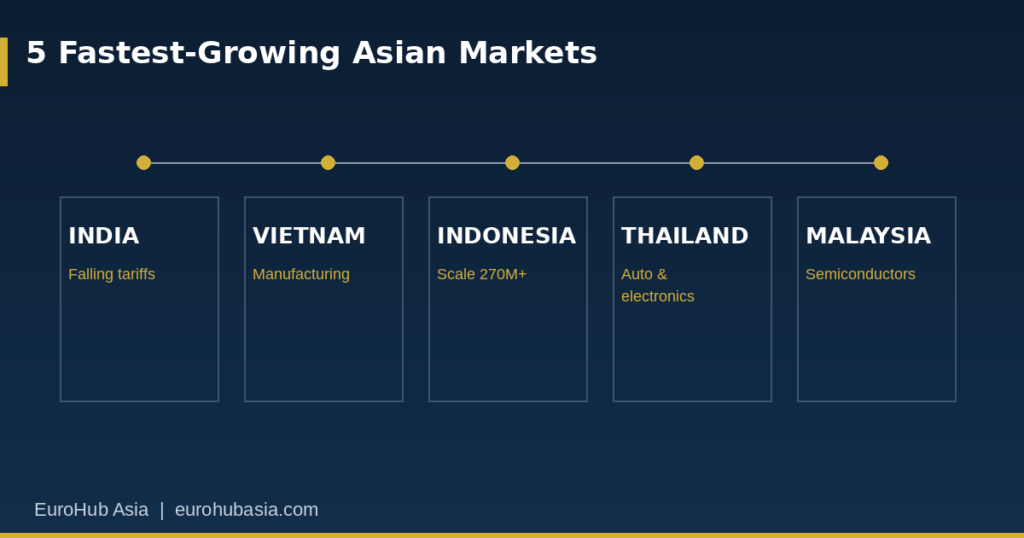
1. India: The Market Where Tariffs Are Disappearing
India deserves the top spot on this list, and the numbers explain exactly why.
Total bilateral trade between the EU and India reached $219.6 billion in 2024–25. That figure breaks down into $136.5 billion in goods and $83.1 billion in services, according to EU-India trade data. This is not a market that is quietly emerging. It is a market that has already arrived and is now accelerating.
What makes India especially compelling right now is the direction of trade policy. Under the new EU-India trade agreement, duties are falling fast across several major sectors:
- Pharmaceuticals: tariffs dropping from up to 11% toward near-zero
- Textiles: tariffs dropping from up to 12% to 0%
- Electronics: tariffs falling from around 14% to 0% on roughly 99.6% of export lines
India’s pharmaceutical exports alone reached $30.47 billion in FY 2024-25, growing 9.4% year over year. Europe already accounts for about 19% of that figure, or roughly $5.8 billion a year, and that was before the newest round of tariff cuts took full effect.
For European businesses selling into India or sourcing from Indian manufacturers, this is one of the clearest “get in early” windows in the current global trade environment. When tariffs fall this quickly, the businesses that arrive first tend to keep the advantage long after the dust settles.
A Market of Scale, Not Just Speed
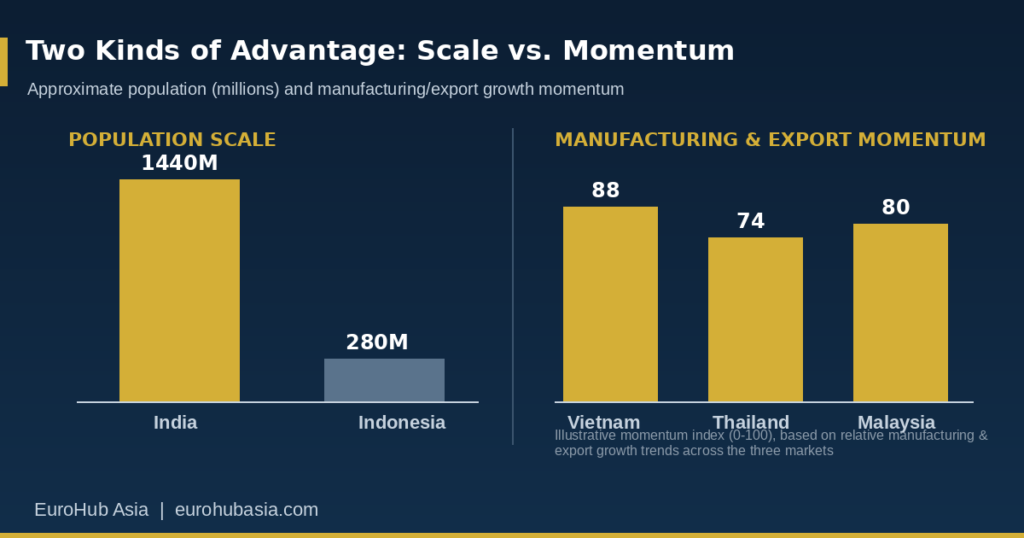
It is worth pausing on just how large India’s domestic market actually is. With well over a billion consumers and a fast-expanding middle class, India offers something most emerging markets simply cannot: enough scale on its own to justify a serious, long-term strategy. A product that finds traction in India is not testing a niche corner of the world. It is proving itself in front of one of the largest consumer bases on the planet.
2. Vietnam: The New Manufacturing Powerhouse
Vietnam has become one of the most talked-about manufacturing destinations in Asia over the past several years, and trade analysts continue to flag it as a market showing strong, sustained industrial growth heading into 2026 and beyond.
Why does this matter for European businesses? Two reasons, and they pull in opposite directions.
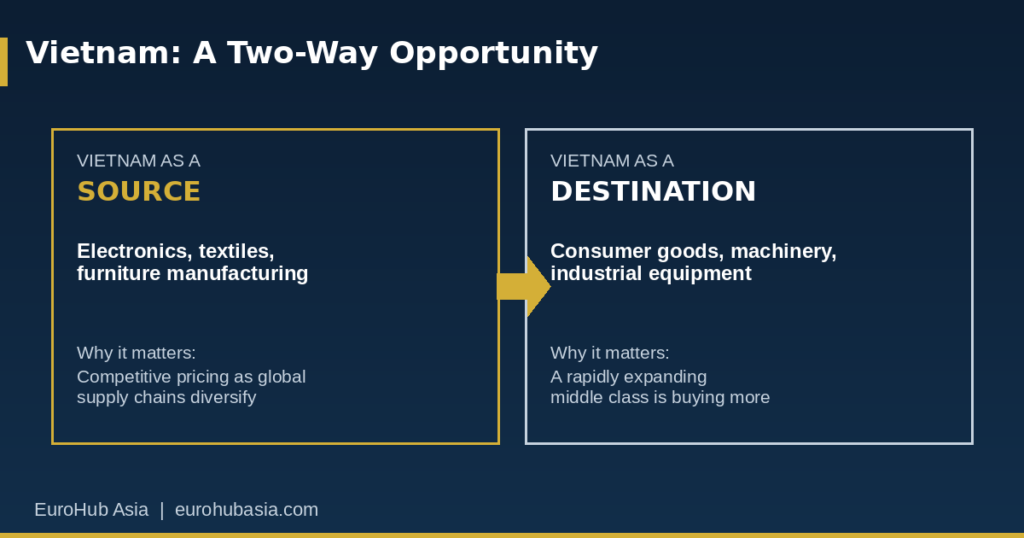
First, Vietnam is a growing source of manufactured goods, from electronic components to textiles and furniture, often at highly competitive pricing. Global manufacturers that once relied almost entirely on a single country for production have been actively diversifying their supply chains, and Vietnam has been one of the biggest beneficiaries of that shift.
Second, and this is the part many businesses overlook, Vietnam’s middle class is expanding rapidly. That means it is also becoming a genuine destination market for European consumer goods, machinery, and specialized industrial equipment. Businesses that treat Vietnam only as a factory floor are leaving money on the table. It is increasingly a two-way trade relationship, and the businesses that recognize this early will be the ones who benefit from both sides of it.
3. Indonesia: Scale Most Businesses Underestimate
Indonesia is the largest economy in Southeast Asia, and its expanding manufacturing base and natural resource sector continue to draw serious international trade interest.
With a population of over 270 million people spread across a vast archipelago, Indonesia offers something few other markets in the world can match: sheer scale, paired with genuine growth momentum. A product that succeeds in Indonesia is not entering a niche market. It is entering one of the largest and most populous consumer bases anywhere on earth.
For European exporters in sectors like machinery, agricultural technology, and industrial equipment, Indonesia’s ongoing infrastructure expansion and manufacturing growth create real, recurring demand rather than a one-off opportunity. This is a market that rewards patience and long-term relationship building over quick, opportunistic deals.
4. Thailand: The Automotive and Electronics Bridge
Thailand has built its reputation as a strong Southeast Asian manufacturing economy, particularly in automotive parts and electronics, earning it the nickname “the Detroit of Asia” among some in the logistics industry.
This matters for European businesses in two distinct ways. If your business manufactures components, machinery, or industrial parts, Thailand’s factories are very often the buyer on the other end of that shipment. If instead you sell finished automotive products or consumer electronics, Thailand’s growing middle class and genuinely strong logistics infrastructure make it a real consumer market in its own right, not just a production hub.
Thailand also benefits from strong regional trade connections across ASEAN, which means a solid foothold there can quietly open doors to neighboring markets as well. In trade, as in life, it rarely hurts to have friends in the right places.
5. Malaysia: The Semiconductor Gateway
Malaysia plays an outsized role in one of the most closely watched global industries right now: semiconductors. It has become a critical link in global supply chains for chip assembly, testing, and packaging, a position that took decades to build and is not easily replicated elsewhere.
For European technology, electronics, and precision equipment exporters, Malaysia is not just another market on a list. It is a strategic partner sitting inside one of the world’s most closely monitored and carefully guarded supply chains. Getting this relationship right can matter far more than the raw trade volume might suggest.
Malaysia also offers a comparatively easier regulatory environment for foreign businesses than some of its regional neighbors, which makes it a practical first step into Southeast Asia for companies that are still new to the region and want to build confidence before expanding further.
Three Ways to Enter These Markets
Once you have picked a market, the next question is always the practical one: how do you actually get in? Most European businesses choose one of three well-worn paths.
1. Direct export. You ship directly from Europe to the destination country, handling your own customs, documentation, and often a local distributor relationship along the way. This approach works well once you already understand the market inside and out, but the learning curve can be steep and expensive on a first attempt, and mistakes here tend to be costly ones.
2. Local distributor or agent. You partner with a company already established in the target market, one that imports, stocks, and sells your product locally. This reduces your risk considerably, but it also means giving up some margin and some control over how your product is positioned and priced.
3. Hub-and-spoke through Dubai. You ship in bulk to a UAE free zone, then distribute onward to multiple Asian markets from that single hub. This approach, which we cover in detail in our article on Dubai as a trade bridge, lets you consolidate logistics, cut down on the number of direct shipping relationships you need to manage, and test several markets at once without committing fully to any single one first. For many businesses, it is the closest thing to having your cake and eating it too.
Most businesses that are new to the region start with a distributor relationship or the hub-and-spoke model, then gradually move toward direct export once they understand the market well enough to manage it independently.
Risk Factors Worth Watching
Fast-growing markets come with fast-changing conditions, and it would be doing you a disservice to pretend otherwise. Before committing significant resources to any of these five markets, it is worth keeping a close eye on the following:
- Currency fluctuations, which can quietly erode your effective pricing and margins from one month to the next
- Regulatory updates, especially around import licensing and product certification requirements
- Local competition, since fast-growing markets naturally attract fast-growing competition from every direction, not just from Europe
- Infrastructure bottlenecks, particularly around ports and logistics networks that are still racing to catch up with demand growth
None of these risks should stop a business from entering a strong market. They are simply reasons to walk in with a clear plan, rather than stumbling in and reacting to problems as they appear.
What These Five Markets Have in Common
Step back and look at these five economies side by side, and a clear pattern starts to emerge. In every single case, growth is being driven by one or more of the following forces:
- Falling tariffs actively opening the door to new price competitiveness, most visibly in India
- Manufacturing diversification, as global supply chains spread their bets across Vietnam, Thailand, and Malaysia rather than concentrating risk in one place
- Sheer population scale, which gives Indonesia and India room to grow that smaller markets simply do not have
- Strategic industry positioning, which has made Malaysia indispensable to the global semiconductor supply chain almost regardless of broader economic conditions
None of these are short-term trends that will fade by next quarter. They are structural shifts in how Europe and Asia trade with one another, and they are likely to keep shaping opportunity for years, not months.
Quick Comparison at a Glance
| Market | Best Known For | Best Fit For |
|---|---|---|
| India | Falling tariffs, pharma, textiles, electronics | Exporters seeking near-term tariff savings |
| Vietnam | Manufacturing growth, rising middle class | Both sourcing and selling |
| Indonesia | Scale: 270M+ population | Consumer goods, machinery, agri-tech |
| Thailand | Automotive and electronics manufacturing | Component suppliers and finished goods sellers |
| Malaysia | Semiconductor supply chains | Technology and precision equipment exporters |
Use this table as a starting point, not a final answer. The right market for your business depends on your specific product, your existing relationships, and how much risk you are genuinely ready to take on in exchange for a faster return.
Why “Fastest-Growing” Does Not Mean “Easiest”
Here is the honest part that most articles on this topic quietly skip over.
Fast growth in a market almost always comes bundled with fast change. Regulations shift without much warning. Import documentation requirements get updated. Currency conditions move overnight. The tariff cuts we mentioned in the India section, for example, are genuinely excellent news for European exporters, but only if your business understands exactly how to qualify for them and files the right paperwork correctly the first time.
This is precisely where a lot of European businesses lose money when entering Asian markets. Not because the opportunity was not real. Because the compliance and logistics side of the operation was not handled correctly from day one, and small mistakes compounded into expensive ones.
A Closer Look: What Makes a Market “Investment-Ready”
Not every fast-growing market is equally ready for a first-time European exporter. Before you commit meaningful resources, it helps to ask a short set of practical questions about any market you are considering; these five are included:
Is the trade policy moving in your favor or against it? India’s falling tariffs are a green light. A market with rising protectionism sends the opposite signal.
Does the market have the physical infrastructure to support your shipment volume? A brilliant market on paper is worth little if the nearest port cannot clear your containers on time.
Is there already a track record of European businesses succeeding there? You do not need to be first. You just need to avoid being the one who arrives before the groundwork exists.
Can you realistically service the market once your product lands? Winning the sale is only half the job. After-sales support, local compliance, and ongoing logistics matter just as much as the initial shipment.
Running through this checklist against each of the five markets above will tell you far more than any single headline statistic ever could.
Frequently Asked Questions
Which of these five markets is easiest for a first-time exporter?
Malaysia is often considered one of the more straightforward entry points in Southeast Asia, thanks to its comparatively simpler regulatory environment for foreign businesses and its well-established trade infrastructure.
Do I need a different strategy for each of these five countries?
Largely, yes. Even within Southeast Asia, import regulations, consumer preferences, and business culture differ significantly from one country to the next. A strategy built for Thailand will not automatically work in Indonesia, and assuming otherwise is one of the most common mistakes first-time exporters make.
How do falling tariffs in India specifically affect a business that is not in pharma, textiles, or electronics?
Even if your specific product category is not directly covered by the current round of tariff cuts, the broader EU-India trade agreement often signals wider trade normalization. This tends to gradually benefit adjacent industries and improve the overall ease of doing business across the board.
Is it better to enter one market first or several at once?
For most first-time exporters, one market first is the safer route. It lets you build real operational experience, work out documentation and logistics issues on a smaller scale, and only then expand with confidence. Spreading resources too thin across multiple new markets at once is a common way for otherwise promising expansions to stall.
The Bottom Line
India, Vietnam, Indonesia, Thailand, and Malaysia represent five genuinely different opportunities, from tariff-driven trade growth to manufacturing scale to strategic supply chain positioning. They do not all offer the same kind of advantage, and that is exactly the point. Between them, they cover nearly every profile of opportunity a European exporter could be looking for.
The common thread running through all five is simple: the businesses that move early, with the right local guidance, are the ones who capture the advantage. The businesses that wait usually arrive only after the easiest opportunities have already been taken by someone else.
Curious which of these five markets fits your product best? Book a free consultation with EuroHub Asia, and we will help you identify the right entry point, the right documentation, and the right first step before your competitors get there first.
Data sources: European Commission and EU-India trade agreement figures; Dubai Chambers and international trade intelligence reports on Asia’s fastest-growing export economies (2025-2026).
Get Trade & Logistics Insights in your inbox
Subscribe to our newsletter for the latest updates on Europe-Asia trade, logistics, and business insights