
Published on the EuroHub Asia Blog
Somewhere in a small workshop in Portugal, a family-run textile business is deciding whether to place its biggest order in ten years. Somewhere in a Frankfurt office, a pharmaceutical importer is staring at a spreadsheet, trying to work out if a new supplier from India is worth the risk. Somewhere in Rotterdam, a renewable energy buyer is signing a contract for solar components that will end up on rooftops across three countries.
None of these people know each other. But they are all standing at the same crossroads, in the same moment, in the same story: the story of Europe-Asia trade moving faster, cheaper, and more closely than at almost any point in recent memory.
Not every industry is growing at the same speed, and not every business will feel this shift equally. But five sectors, in particular, are moving so fast right now that the businesses inside them have a real, measurable head start over everyone still sitting on the sidelines. This article is about those five industries, the honest numbers behind them, and what this moment might mean for a business like yours.

Behind Every Statistic Is a Business Like Yours
It is easy to read trade numbers and feel like they belong to someone else. Billions of euros, national export figures, and tariff percentages—they can feel abstract, distant, and almost like weather reports for a country you do not live in.
But every one of those numbers is made up of thousands of individual decisions. A factory owner in Vietnam deciding to expand a production line. A buyer in Munich deciding to switch suppliers. A logistics manager in Dubai is deciding which route saves the most money this quarter. Trade is not really about numbers. It is about people making decisions that ripple outward, decision by decision, shipment by shipment, until they add up to a headline figure.
That is the spirit in which we want you to read the five industries below. Not as abstract statistics, but as five real opportunities, each one built from thousands of small, human decisions that are already happening. The only open question is whether your business is one of the ones making that decision or one of the ones watching from a safe distance.
1. Pharmaceuticals: A Sector Where Trust Meets Speed
There is something quietly moving about the pharmaceutical trade. At its core, it is not just about margins and tariffs. It is about medicine reaching the people who need it, faster and more affordably than before.
Pharmaceutical trade between Europe and Asia is accelerating quickly, and India is leading the way. India’s pharmaceutical exports reached $30.47 billion in FY 2024-25, a 9.4% increase year over year. Europe already represents about 19% of that total, roughly $5.8 billion a year, and that figure was recorded before the newest round of tariff cuts fully took hold.
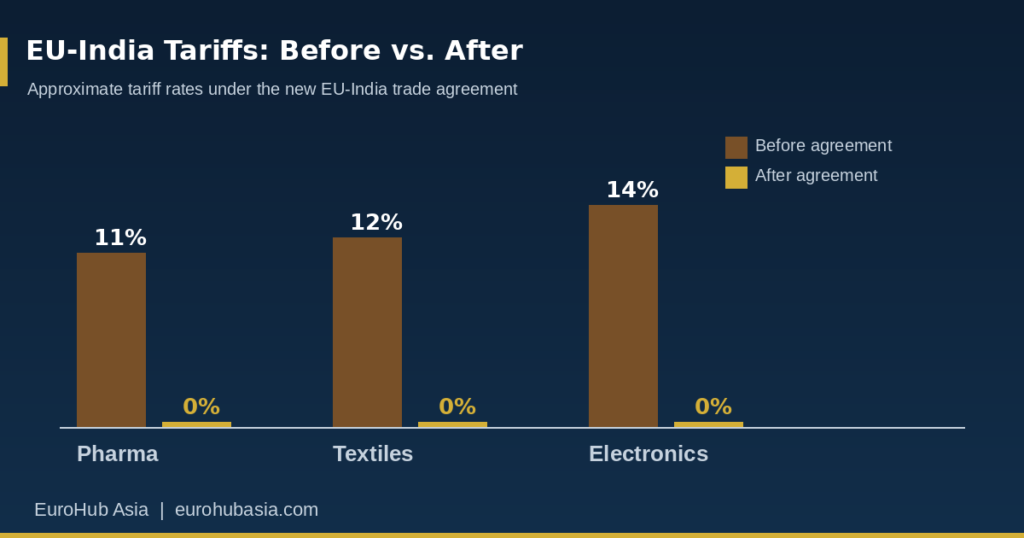
What makes this sector especially compelling right now is the direction of trade policy. Under the new EU-India trade agreement, tariffs on pharmaceutical products are falling from as high as 11% toward near-zero. Lower tariffs mean lower landed costs, which means better margins for exporters and importers alike, and in many cases, lower prices for the patients who ultimately depend on these medicines.
For European pharmaceutical and healthcare businesses, this is a rare and fortunate combination: a large, established manufacturing base, strong quality standards, and a trade policy environment actively becoming more favorable, all arriving at the same time.
The Quiet Advantage of Being Early
Businesses that move into a market while the tariff advantage is still fresh tend to build supplier relationships, documentation habits, and market knowledge that are difficult for latecomers to copy quickly. In pharmaceuticals, where trust and compliance take years to build, this early-mover advantage is worth far more than the tariff savings alone.
2. Textiles and Apparel: Fashion’s Quiet Supply Chain Shift
Fashion moves fast. Supply chains, historically, have not. That is beginning to change, and the change favors businesses paying close attention right now.
The EU imports a massive volume of textiles and apparel every year, approximately €176.9 billion in 2023. A meaningful share of that comes from Asia, and the competitive landscape inside that share is shifting in a way that deserves real attention.
India’s textile exports to the EU currently sit around $7 to $7.2 billion. Here is the important shift: tariffs on Indian textiles are dropping from up to 12% to 0% under the new trade agreement. Previously, Indian textile suppliers were at a pricing disadvantage compared to competitors in Bangladesh, Pakistan, and Turkey, who already benefited from lower duty rates. That disadvantage is now quietly disappearing, and it is opening doors that were closed just a few years ago.
For European fashion brands, retailers, and textile importers, this means more competitive sourcing options are opening up in a market that already offers strong manufacturing capacity, skilled labor, and improving quality standards. It is not simply about finding a cheaper supplier. It is about finding a better positioned one at a moment when the ground beneath the entire industry is shifting.
3. Electronics: The Sector Where Small Savings Become Big Numbers
Electronics is one of the largest trade categories in the world, and Asia dominates global manufacturing in this space almost completely. But what makes this sector worth a closer look right now is not its size. It is the speed at which the cost of doing business inside it is falling.
India’s electronics exports to the EU reached approximately $11.3 billion in FY 2024-25, with smartphones alone accounting for $4.3 billion of that figure. The EU’s total electronics market is valued at roughly $750 billion, which gives a real sense of just how much room there still is for growth within this single relationship.
Tariffs here are falling dramatically too, from around 14% down to 0% on approximately 99.6% of electronics export lines under the new EU-India agreement. For European technology retailers, component buyers, and manufacturers, this is a sector where cost savings from tariff elimination can be substantial, especially for businesses moving high volumes of electronics trade every quarter.
A Simple Way to See What This Means
Imagine your business imports $100,000 worth of electronics components from India in a year. At a 14% tariff, you would pay $14,000 in import duties. At 0%, under the new agreement, you pay nothing. That $14,000 is not a small efficiency gain tucked away in a footnote. For many small and mid-sized businesses, it is the difference between a project being genuinely profitable or barely worth pursuing at all. Multiply that across a full year of regular shipments, and the savings become significant enough to change hiring plans, pricing strategy, or how ambitious your expansion timeline can afford to be.
4. Renewable Energy Components: Powering a Promise
There is something almost poetic about this sector. Europe has made a public promise to its own citizens, a promise to slow climate change, to build a cleaner future, to leave something better behind for the next generation. And quietly, behind that promise, sits an enormous and growing trade relationship with Asia.
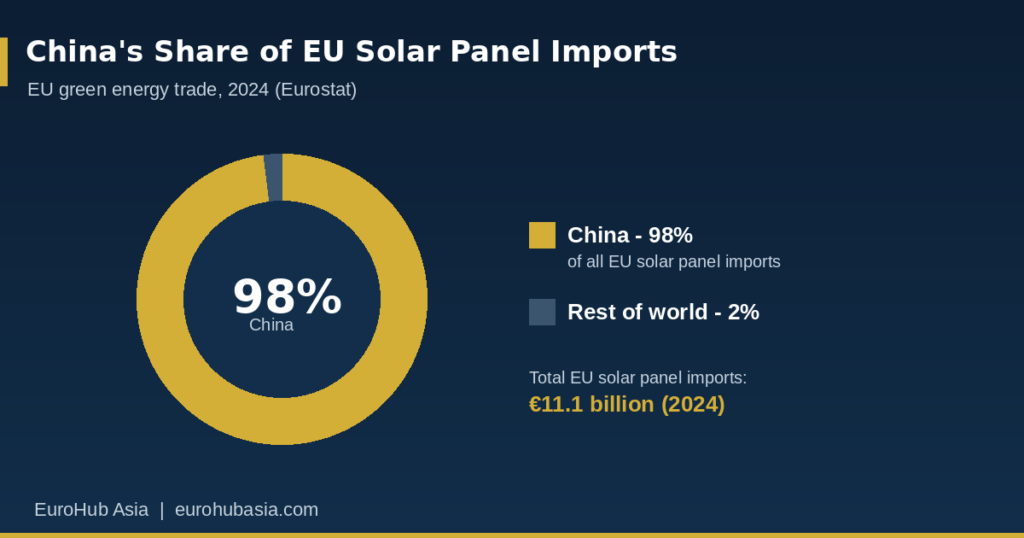
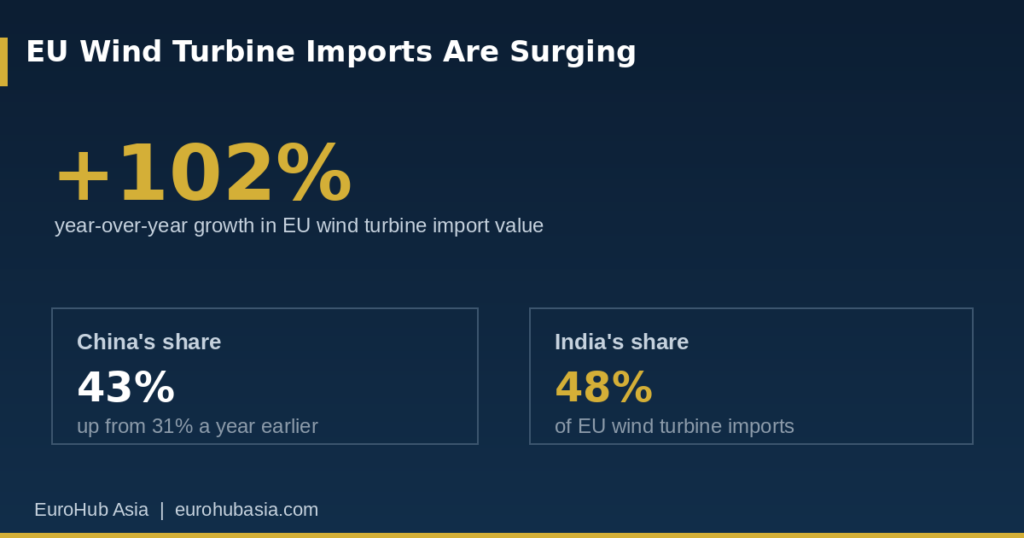
In 2024, the EU imported €14.6 billion in green energy products. Solar panels made up the largest share at €11.1 billion, with China supplying an extraordinary 98% of all EU solar panel imports. Wind turbines tell an equally striking story. Import value surged 102% year over year, and China’s share of EU wind turbine imports jumped from 31% to 43% in a single year. India also plays a major role here, supplying 48% of EU wind turbine imports.
This is a sector defined by speed and by conviction. Europe’s climate targets are not slowing down, and neither is its dependence on Asian manufacturing to hit them. For businesses in logistics, component distribution, or renewable energy supply chains, this growth curve shows no real signs of flattening, and every rooftop solar panel or offshore wind turbine represents a genuine, physical piece of that promise being kept.
5. Agri-Food: The Sector That Feeds the Relationship
There is a saying worth remembering here: everybody eats. No matter how fast technology changes or how supply chains evolve, food remains the one category of trade that never truly slows down. It only shifts in shape.
Agriculture and food products remain one of Europe’s largest and most resilient export categories. EU agri-food exports reached a record €238.4 billion in 2025, a modest but steady 1% increase over the previous year’s record of €235.4 billion. While exports to China specifically declined in 2025, the EU maintained a well-diversified portfolio of markets across the world, including across Asia.
This diversification is genuinely good news for businesses entering this space now. It means opportunity is not concentrated in one single Asian market, waiting to be won or lost on the fortunes of one relationship. Businesses that build connections across multiple Asian countries, rather than betting everything on one, tend to be the ones best positioned to weather shifts in any single market, the same way a farmer who plants several crops is better protected than one who plants only one.
For European agri-food producers and Asian importers alike, the real opportunity lies in specialization. Premium, certified, or specialty food products tend to perform best when broad commodity trade faces more competition and price pressure. It rewards businesses willing to tell a story about their product, not just sell a commodity.
Why Falling Tariffs Matter More Than Most Businesses Realize
It is easy to read “tariffs dropping from 14% to 0%” and not fully register what that actually means in real money, in real decisions, and in a real business’s ability to grow or simply survive a difficult quarter.
Think back to the electronics example above. That $14,000 saved on a single $100,000 shipment is not just a number on a spreadsheet. For a small business, it could be the cost of hiring one more employee. For a mid-sized importer, it could be the difference between absorbing a bad quarter or having to lay someone off. Trade policy, at its heart, is never really about policy. It is about the people whose livelihoods sit downstream of these decisions.
This is exactly why businesses trading in pharmaceuticals, textiles, and electronics with India should be reviewing their tariff classifications and paperwork right now, not waiting until renewal time, not waiting until a competitor gets there first.
Two More Categories Worth Watching
Beyond the five core industries above, two additional categories are quietly building momentum and deserve a place on your radar.
Medical devices. Closely related to pharmaceuticals, medical device trade between Europe and Asia is growing alongside rising healthcare investment across South and Southeast Asia. Europe’s strong reputation for medical device quality standards continues to be a genuine competitive advantage in these markets, the kind of trust that cannot be built overnight by a new competitor.
Agri-tech and food processing equipment. As agri-food trade volumes grow, so does demand for the machinery and technology used to process, package, and preserve food products. European agri-tech manufacturers are well positioned to supply this demand as Asian food processing industries modernize, often replacing manual processes with equipment that improves both safety and shelf life.
Neither of these categories has the same scale of hard data available yet as the five industries covered above, but both are worth watching closely over the next year, the way a good investor watches a promising company before the rest of the market notices it.
How to Know If Your Business Is Ready to Act
Reading about opportunity is one thing. Knowing whether your specific business is positioned to act on it is another. Before you commit real time and money to one of these five industries, ask yourself these questions honestly.
Is your product or service inside one of these five categories or closely adjacent to one? You do not need to force-fit your business into a trend that does not belong to it. But if you are already close, the tariff and demand shifts described here may already be working in your favor without you fully realizing it yet.
Do you understand the real, all-in cost of trading in this sector, not just the tariff rate? Falling tariffs are excellent news, but customs clearance, certification, insurance, and logistics still add real cost. Businesses that only look at the headline tariff number are often surprised later.
Can your business handle a sudden increase in order volume if demand grows faster than expected? Falling tariffs and rising demand can create growth that arrives faster than a business is prepared for. It is worth thinking through this now, while there is still time to plan calmly.
Do you have a trade partner who understands both sides of this relationship? The businesses that succeed fastest in these five industries are rarely the ones working alone. They are the ones who found a partner in logistics, customs, or market entry who could translate opportunity into action.
Five Industries at a Glance
| Industry | Key Number | What’s Driving Growth |
|---|---|---|
| Pharmaceuticals | $30.47B in India exports (+9.4% YoY) | Tariffs falling from 11% toward zero |
| Textiles & Apparel | €176.9B EU import market | Tariffs falling from 12% to 0% |
| Electronics | $11.3B India-to-EU exports | Tariffs falling from 14% to 0% on 99.6% of lines |
| Renewable Energy | €14.6B EU green energy imports | Europe’s climate targets, 98% China solar share |
| Agri-Food | €238.4B EU exports (record) | Steady demand, market diversification |
This table is a snapshot, not the whole picture. Each of these five numbers represents years of underlying policy and infrastructure changes, and each is likely to keep shifting as new trade agreements and climate targets take effect over the coming years. Use it as a starting point for a conversation, not a final answer on its own.
The Human Cost of Waiting Too Long
There is a quiet risk in all of this that rarely gets discussed openly: the cost of doing nothing. It is easy, understandably so, to want more certainty before making a move. To wait for one more report, one more confirmation, one more sign that the timing is right.
But markets that are already moving do not wait for anyone to feel ready. The businesses that eventually look back at this period and feel proud of their timing will not be the ones who waited for perfect certainty. They will be the ones who did their homework, moved with reasonable confidence, and adjusted course along the way. Nothing about international trade is ever completely risk-free. But standing still carries a risk too; it is simply a quieter one, easier to ignore until a competitor has already claimed the ground you were hesitating over.
Frequently Asked Questions
Which of these five industries offers the fastest return for a new entrant?
Pharmaceuticals and electronics currently offer the clearest near-term advantage, thanks to the rapid tariff reductions already in motion. Businesses already active in these sectors should prioritize reviewing their documentation now, rather than waiting for the next renewal cycle.
Is the renewable energy opportunity mostly about solar panels?
Solar panels represent the largest single category by value, but wind turbine imports are growing even faster in percentage terms, up 102% year over year. Businesses focused only on solar may be overlooking a faster-growing adjacent opportunity sitting right next to it.
Why did EU agri-food exports to China decline even as the overall category grew?
This is a useful reminder that overall sector growth does not mean every individual market within that sector is growing at the same pace. It is exactly why diversifying across multiple Asian markets, rather than depending on one, tends to produce more stable, resilient results over time.
Do I need to be a large company to take advantage of these shifts?
Not at all. Many of the businesses best positioned to benefit from falling tariffs and rising demand are small and mid-sized companies that can move quickly, adapt their sourcing, and build direct relationships without layers of internal approval slowing them down.
What These Five Industries Have in Common
Look closely at these five sectors side by side, and a clear pattern begins to emerge. In every single case, growth is being driven by one or more of the following forces:
- Falling tariffs actively opening up new price competitiveness, most visibly in pharmaceuticals, textiles, and electronics
- Structural demand shifts that show no real signs of slowing down, most visible in renewable energy
- Diversification strategies that reward businesses trading across multiple markets rather than depending on just one, most visible in agri-food
None of these are short-term trends destined to fade by next quarter. They are structural shifts in how Europe and Asia trade with each other, and they are likely to continue shaping opportunity for years, not months, for the businesses paying close enough attention to notice.
The Bottom Line
Whether your business sells pharmaceuticals, textiles, electronics, renewable energy components, or agricultural products, the current trade environment between Europe and Asia offers a genuinely strong window of opportunity, backed by real, verifiable data rather than hopeful guesswork.
The businesses that benefit most will not be the ones who simply read about these numbers and nod along. They will be the ones who act on them, thoughtfully and deliberately, with the right partner handling documentation, logistics, and compliance along the way, so that opportunity does not quietly slip past while the paperwork catches up.
Is your industry one of these five? Speak with EuroHub Asia about how to position your business for this growth, with the right trade partners and the right paperwork in place from day one.
Data sources: European Commission agri-food trade reports; Eurostat green energy trade statistics; EU-India trade agreement figures; Dubai Chambers trade reports (2024-2025).
Get Trade & Logistics Insights in your inbox
Subscribe to our newsletter for the latest updates on Europe-Asia trade, logistics, and business insights