
Published on the EuroHub Asia Blog
Elena had been waiting for this shipment for six weeks. Three hundred electronic components, ordered from a supplier in Asia, meant to keep her small assembly line in Germany running through the busiest quarter of her year. She had already promised delivery dates to her own customers. She had already told her team the parts were “almost here.”
Then the shipment reached port and simply stopped moving.
Not because anything was wrong with the product. Not because of a shipping delay, a storm, or a strike at the port. It stopped because one document, a Certificate of Origin, listed a manufacturing location that did not quite match what customs records expected for that product code. A tiny mismatch. A few words on a piece of paper. And suddenly, three hundred perfectly good components sat in a customs warehouse for eighteen days while Elena made phone call after phone call, trying to understand what had gone wrong and how to fix it.
This story is not rare. It is not even unusual. It happens to businesses trading between Europe and Asia every single week, and almost all of it is avoidable. Most trade mistakes, it turns out, are never really about the product at all. They are about the paperwork sitting quietly behind it, the part nobody thinks about until it is already too late.
Why This Matters More Than Most Businesses Realize
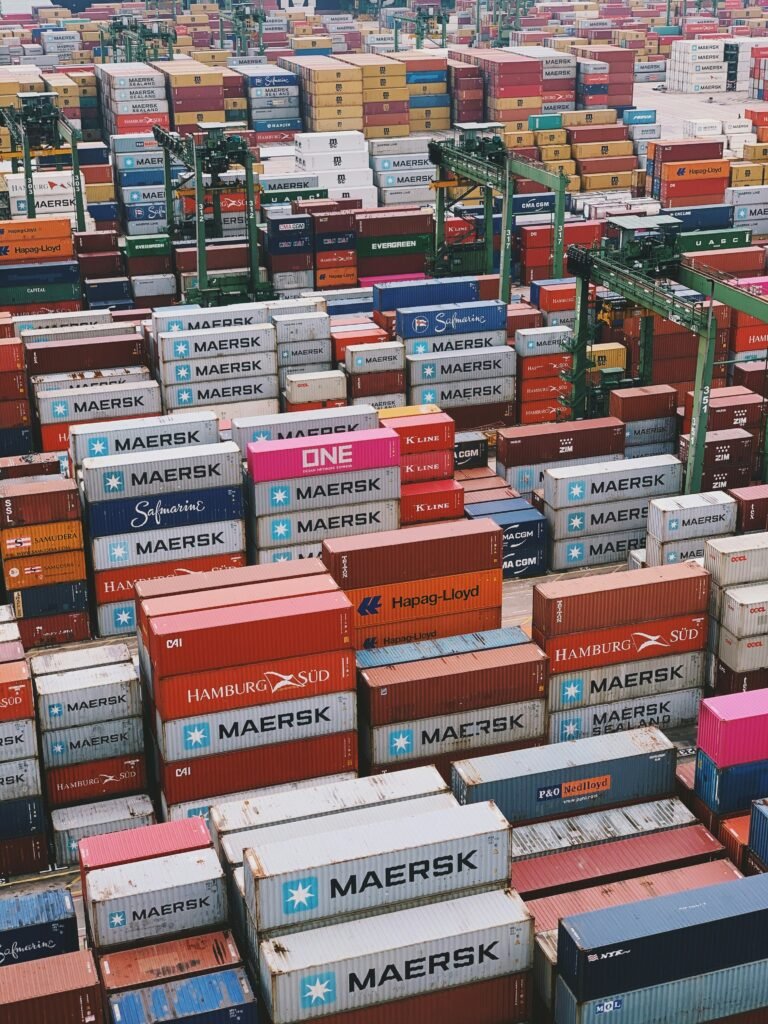
It is easy to think of compliance as boring background work, the unglamorous cousin of the “real” business of finding customers and closing deals. But behind every smooth, on-time shipment sits a mountain of paperwork that most people never see, and behind every delayed one usually sits a single missing or mismatched document.
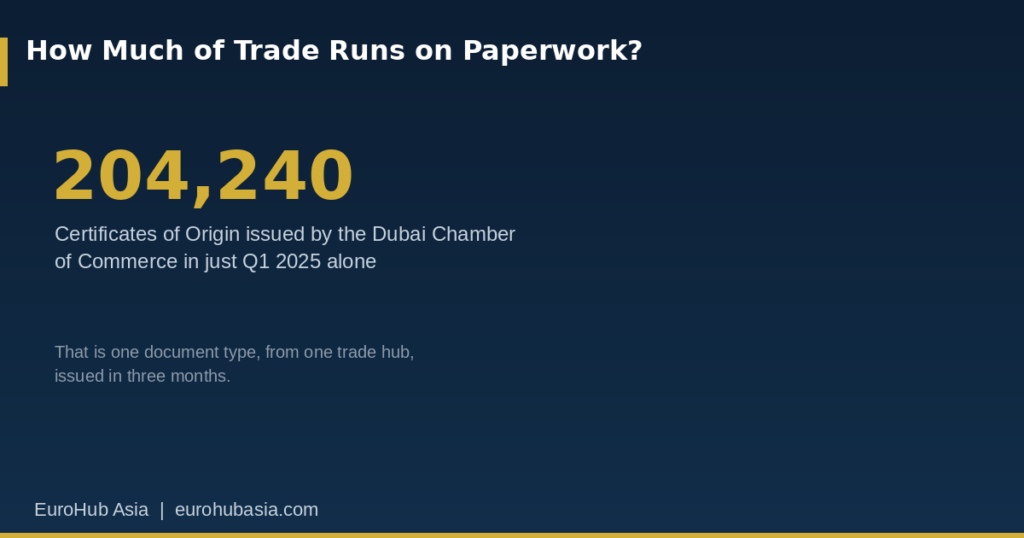
Consider this: the Dubai Chamber of Commerce alone issued 204,240 Certificates of Origin in just the first quarter of 2025. That is one document type, from one trade hub, in three months. It is a quiet reminder of just how much of international trade genuinely runs on paperwork, not simply on containers moving across oceans.
And the rules are not standing still. Under the new EU-India trade agreement, for example, tariffs are dropping fast: pharmaceuticals from up to 11% toward zero, textiles from up to 12% down to 0%, and electronics from around 14% to 0% on nearly all export lines. Businesses that do not update their documentation and tariff codes to reflect these changes risk overpaying duties they no longer owe, or worse, underpaying and facing penalties months later when someone finally notices the gap.
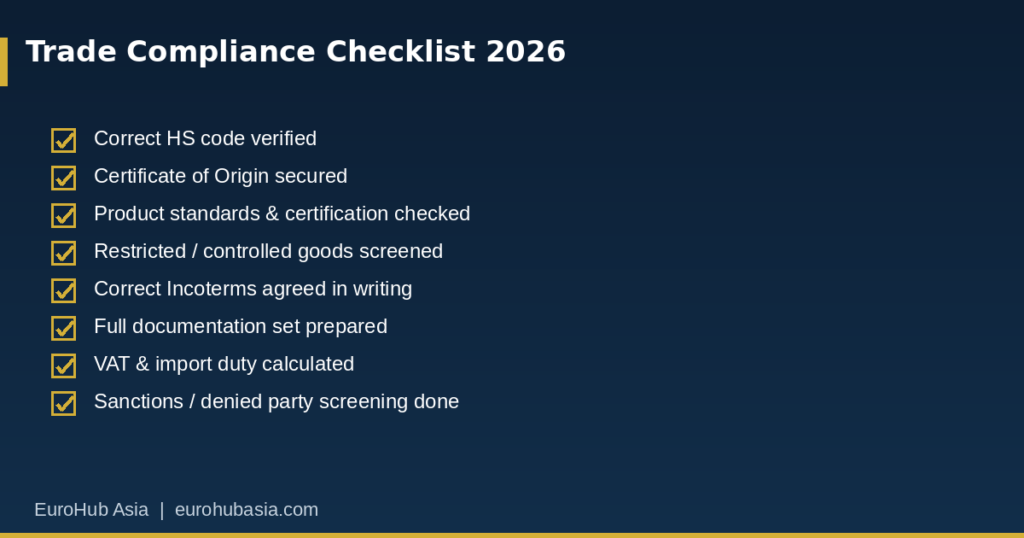
Here is your full trade compliance checklist for 2026, the same one we walk through with our own clients at EuroHub Asia before every shipment.
1. Get Your HS Code Right
Every product traded internationally is classified under a Harmonized System, or HS, code. Think of it as your product’s passport number. It determines the duty rate you pay, whether your product needs special permits, and whether it qualifies for any trade agreement benefits at all.
The mistake. Many businesses copy an HS code from a supplier or a competitor without ever verifying it themselves- the trade equivalent of copying someone’s homework and hoping the answers still apply to your own exam. A single wrong digit can mean paying the wrong tariff rate, or worse, triggering a customs inspection that holds up an entire shipment.
What to do. Verify your HS code independently for every product line, and re-check it whenever a new trade agreement changes the tariff structure for your category. This is a five-minute task that can save weeks of trouble later.
2. Secure the Right Certificate of Origin
A Certificate of Origin proves where your goods were actually manufactured, not where they happened to be shipped from. It is often required to clear customs at the destination country, to qualify for reduced tariffs under a trade agreement, and to satisfy the buyer’s own import documentation requirements.
The mistake. Assuming origin simply means “wherever you shipped from.” This is exactly the assumption that cost Elena eighteen days. Origin rules are based on manufacturing and processing location, not shipping location, and the rules differ by product and by trade agreement, sometimes in ways that are genuinely easy to misunderstand.
What to do. Confirm the correct rules of origin for your specific product and trade lane before shipping, not after a customs official starts asking questions. An ounce of prevention here truly is worth a pound of cure.
3. Understand Your Product Standards and Certifications
Different regions require different product certifications before goods can legally enter the market. In Europe, many products require CE marking, confirming compliance with EU health, safety, and environmental standards. In GCC countries, including the UAE, many products require GCC Conformity Marking (G-Mark) or country-specific certification. Certain sectors, food, pharmaceuticals, electronics, and cosmetics, among them, often need additional sector-specific approvals on top of these.
The mistake. Shipping a product that is perfectly legal, even celebrated, in your home market but missing the one required certification mark for the destination market. It is a bit like showing up beautifully dressed for the wrong party.
What to do. Check destination-market certification requirements for your exact product category before manufacturing runs are finalized, not after the goods are already packed, labeled, and halfway to the port.
4. Check Restricted and Controlled Goods Lists
Some products face additional restrictions, licensing requirements, or outright bans depending on the destination country. This can include chemicals and industrial materials, certain electronics and dual-use technology, food and agricultural products subject to biosecurity rules, and pharmaceuticals or medical devices.
The mistake. Assuming that because a product is freely sold at home, it faces no restrictions abroad. What is perfectly ordinary on one side of the world can be tightly controlled on the other.
What to do. Screen every new product line against the destination country’s restricted and controlled goods list before your first shipment, not your fifth, when a bad habit has already had time to quietly take root.
5. Use the Correct Incoterms
Incoterms, short for International Commercial Terms, define exactly who is responsible for shipping costs, insurance, customs clearance, and risk at each stage of a shipment. Common terms include FOB, or Free On Board, where the seller handles export clearance and loading while the buyer takes over from there; CIF, or Cost, Insurance, Freight, where the seller covers shipping and insurance all the way to the destination port; and DDP, or Delivered Duty Paid, where the seller handles everything, including the destination country’s import duties.
The mistake. Using vague or informal shipping terms in a contract, the kind of loose language that feels fine in a friendly email exchange but leads to real disputes later over who pays customs duties or who is liable if goods are damaged in transit.
What to do. Always specify Incoterms clearly and correctly in every contract and shipping document. When in doubt, get this confirmed in writing before the shipment ever leaves the warehouse. A handshake is warm, but a written Incoterm is what actually protects you.
6. Prepare the Complete Documentation Set
At minimum, a standard international shipment requires a commercial invoice, a packing list, a Certificate of Origin, a Bill of Lading for sea freight or an Air Waybill for air freight, an insurance certificate where applicable, and any product-specific certificates such as CE marking or health certificates.
The mistake. Submitting an incomplete document set is quietly one of the most common reasons shipments are delayed at customs. It rarely feels like a big mistake in the moment. It just feels like “we’ll send the rest later.” Customs rarely agrees.
What to do. Build a standard document checklist for your business, and confirm every single item is prepared and accurate before the shipment departs, not after it has already arrived at the port and the clock has started ticking against you.
7. Confirm VAT and Import Tax Obligations
Value-added tax and import duties apply differently depending on the destination country, the product category, and the trade agreement in place. These numbers are not decoration on an invoice. They are real money that has to come from somewhere.
The mistake. Quoting a price to a buyer without factoring in the destination country’s VAT or import tax, which leads to awkward disputes or unexpected costs later, usually right when the relationship should be at its warmest.
What to do. Calculate the full landed cost, including all applicable taxes and duties, before finalizing pricing with any buyer. It is far easier to have this conversation once, upfront, than to explain a surprise invoice after the goods have already shipped.
8. Screen for Sanctions and Denied Parties
Before finalizing any new international trade relationship, check that neither party appears on any relevant sanctions or denied party lists. This step is often overlooked by smaller businesses but is taken very seriously by customs authorities and banks alike.
The mistake. Skipping this step because a business “seems legitimate.” Appearances, unfortunately, are not a compliance strategy.
What to do. Run a denied party screening check as a standard step for every new trade partner, every single time, the same way you would double-check a lock on your own front door even on a quiet street.
A Day in the Life of a Shipment That Goes Right
It is worth pausing to imagine the opposite of Elena’s story, because it is just as real and far more common than the horror stories that tend to get told.
A shipment leaves a factory in Vietnam with every document already prepared and cross-checked days in advance. The Certificate of Origin matches the HS code exactly. The Incoterms were agreed upon in writing weeks earlier, so nobody is confused about who is responsible for what. The buyer in the Netherlands already knows the landed cost down to the last euro, because someone calculated it properly before the deal was ever signed. When the container reaches port, customs clears it in a single day, almost invisibly, the way a smooth journey often goes unnoticed simply because nothing went wrong.
This is what compliance actually buys a business: not excitement, but its opposite. Boredom, in the best possible sense. A shipment nobody has to think twice about.
The Real Story Behind Elena’s Eighteen Days
Let’s return to Elena, because her story deserves a proper ending, not just a cautionary beginning.
The mismatch, once found, took less than an hour to properly diagnose. The manufacturing location on the Certificate of Origin had been copied from an old template, one that referenced a factory the supplier had used two years earlier before shifting production to a newer facility. Nobody had updated the document. It was not fraud. It was not even carelessness, exactly. It was simply a small detail that slipped through the cracks, because nobody had built a habit of checking it.
Eighteen days of storage fees. Eighteen days of a delayed production line waiting for those components. Eighteen days of a customer asking, politely at first and less politely later, why their order had not shipped yet. Nothing was wrong with the product itself, not one single component. Everything was wrong with one paragraph on one document that a five-minute pre-shipment check would have caught immediately.
Elena now runs that same check on every shipment, without fail. It takes her supplier a few extra minutes to confirm. It has never cost her eighteen days again.
The Emotional Weight Nobody Talks About
There is a side to compliance failures that rarely makes it into checklists like this one, and it deserves at least a mention: the quiet stress of not knowing why something has gone wrong or how long it will take to fix.
For a small business owner, an eighteen-day delay is not just a logistics problem on a spreadsheet. It is a string of difficult phone calls. It is lying awake wondering whether a customer will walk away. It is the particular kind of tiredness that comes from a problem you cannot simply fix by working harder, only by waiting, and hoping the paperwork gets sorted before patience runs out on the other end of the line.
This is exactly why compliance work, unglamorous as it sounds, deserves real respect. It is not red tape for its own sake. It is what stands between a business having a calm, predictable week, and having a genuinely difficult one.
Two Warning Signs Worth Taking Seriously
Most compliance failures do not arrive without warning. They usually leave small clues behind if someone knows to look for them.
A supplier who reuses the exact same documents, shipment after shipment. Consistency sounds like a good thing, and often it is. But if a Certificate of Origin, a packing list, or a product certificate never seems to change even as factories, product lines, or regulations shift, it is worth asking whether those documents are being genuinely reissued each time, or simply copied forward out of habit. Elena’s supplier fell into exactly this pattern, and it is a far more common habit than most businesses realize.
A tariff rate that “sounds about right” rather than one that has been checked. Trade agreements move quietly and often, and a rate that was accurate eighteen months ago may no longer reflect reality. If nobody on your team can point to the specific, current source for a duty rate, that is a sign worth taking seriously, not a detail to wave away.
Neither warning sign guarantees a problem. But both are worth a five-minute conversation before they quietly become an eighteen-day one.
A Simple Pre-Shipment Ritual You Can Actually Stick To
Checklists have a way of gathering dust in a folder somewhere, opened once with good intentions and never looked at again. The businesses that actually stay compliant, shipment after shipment, tend to do one thing differently: they turn the checklist into a short, repeatable ritual rather than a long document to be read.
Before your next shipment leaves, try setting aside fifteen focused minutes, not to read every clause of every regulation, but simply to ask seven quick questions out loud, or write them down where your team can see them. Is the HS code verified for this exact product, not just copied from the last shipment? Does the Certificate of Origin actually match current production, not an old template? Are all destination-market certifications confirmed and current? Have restricted and controlled goods been screened for this specific product line? Are the Incoterms written down clearly, not simply assumed? Is the full documentation set complete and accurate? And finally, has the landed cost, taxes, and duties included, actually been calculated rather than estimated?
Fifteen minutes, seven questions, every single time. It is a small ritual with an outsized payoff, the difference between a shipment that moves smoothly through customs and one that spends eighteen days becoming somebody’s cautionary story.
Frequently Asked Questions
Who is actually responsible for compliance, the buyer or the seller? This depends on the Incoterms agreed upon in the contract, but in practice, both sides share responsibility. The exporter typically prepares origin and product documentation, while the importer is usually responsible for import duties and destination country compliance. Clear Incoterms, agreed in writing, prevent most of the confusion about who does what.
How often do trade agreement tariff rates actually change? More often than most businesses expect. Agreements like the EU-India trade deal are phasing in changes over several years, meaning tariff rates on the same product can shift multiple times as the agreement matures. Reviewing your tariff classifications at least once a year is good practice, and reviewing them after any major trade agreement update is even better.
Do small businesses really need to worry about denied party screening? Yes. Screening requirements generally apply regardless of business size. Banks processing international payments often run their own checks too, and a flagged transaction can delay payment even if the shipment itself is completely fine. Being small does not make a business invisible to these checks; it only makes the disruption harder to absorb when it happens.
What is the single most common compliance mistake you see? Outdated documentation, more than any single error. A Certificate of Origin copied from an old template. An HS code carried over from a previous shipment without rechecking. A tariff rate quoted from memory instead of the current agreement. None of these come from carelessness exactly. They come from good habits that were never quite built in the first place.
Where Shipments Actually Get Stuck
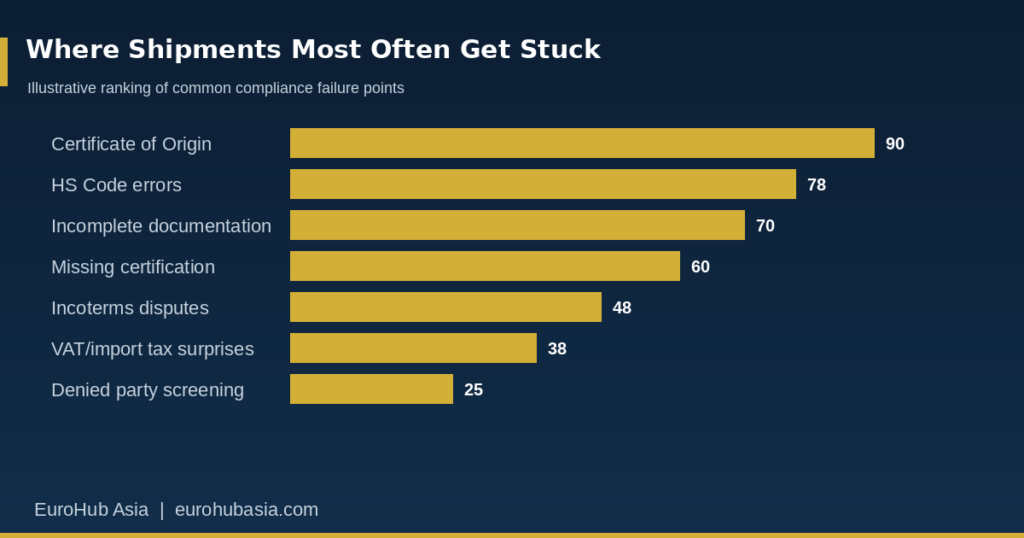
Not every compliance failure looks the same, and understanding where problems tend to cluster can help a business focus its attention where it matters most.
| Compliance Area | Common Failure Point | Typical Consequence |
|---|---|---|
| HS Code | Copied without verification | Wrong duty rate, customs inspection |
| Certificate of Origin | Outdated or mismatched details | Shipment held at port |
| Product Certification | Missing destination-market mark | Goods refused entry |
| Incoterms | Vague or undocumented terms | Payment and liability disputes |
| Documentation Set | Incomplete paperwork | Customs delay |
| VAT and Import Tax | Not calculated upfront | Pricing disputes with buyer |
| Denied Party Screening | Skipped entirely | Payment or shipment blocked |
This table is not meant to frighten anyone away from international trade. Quite the opposite. Every single row on it represents a problem with a known, simple fix. The businesses that struggle are rarely the ones facing unusual circumstances. They are usually the ones who never wrote the checklist down in the first place.
The Real Cost of Getting This Wrong
Compliance mistakes are rarely just an inconvenience. They typically cost businesses in three distinct ways. There are direct financial penalties from customs authorities, the kind that show up as an unwelcome line item nobody budgeted for. There are delayed shipments, sometimes for weeks, quietly damaging relationships with buyers who have their own customers waiting in turn. And there are overpaid duties, which may be the most invisible cost of all, when businesses fail to claim reduced tariff rates they actually qualify for under current trade agreements and simply never notice the money slipping away.
The tariff changes happening right now under agreements like the EU-India trade deal are a perfect example of this last point. Businesses that keep their documentation updated will save real money, sometimes a great deal of it. Businesses that do not will simply keep overpaying, quietly, shipment after shipment, never quite realizing there was ever a choice in the matter.
Building the Habit, Not Just the Checklist
A checklist only works if someone actually uses it every time, especially on the days when everyone is busy and it would be so much easier to skip a step. The businesses that handle compliance well are rarely the ones with the most complicated systems. They are the ones who have simply made these eight checks a habit, the same unremarkable way someone checks their mirrors before changing lanes, without needing to think hard about it each time.
Time is money in international trade, perhaps more than in almost any other kind of business. But the businesses that move fastest, in the end, are usually not the ones who skip the paperwork. They are the ones who handle it so smoothly and so consistently that it never has the chance to slow them down in the first place.
The Bottom Line
None of these eight checkpoints are complicated on their own. The real challenge is remembering to check all of them, every time, for every shipment, especially as trade agreements and tariff rates keep shifting beneath everyone’s feet. This is exactly the kind of detail work that turns a stressful, unpredictable trade relationship into a smooth, repeatable one, the kind where a business can actually promise a delivery date and mean it.
Elena’s eighteen days taught her something that no amount of reading a checklist alone could have. Sometimes the smallest details carry the heaviest consequences, and the businesses that thrive are the ones who learn that lesson from someone else’s story, rather than having to live through their own.
Want a compliance check before your next shipment between Europe and Asia? Contact EuroHub Asia, and we will review your documentation, tariff classification, and certification requirements before you ship, not after something goes wrong.
Data sources: Dubai Chamber of Commerce Q1 2025 trade report; EU-India trade agreement tariff schedules; general international trade compliance standards.
Get Trade & Logistics Insights in your inbox
Subscribe to our newsletter for the latest updates on Europe-Asia trade, logistics, and business insights