
Why Europe–Asia trade matters for UAE buyers in 2026
The UAE has never traded more with the world, and it has never been harder to plan a shipment. Both things are true at the same time in 2026, and every buyer in the Gulf needs a plan for both.
On the growth side, the numbers are huge. The UAE’s non-oil foreign trade passed AED 3.8 trillion in 2025 for the first time ever. In the first half of 2026 alone it reached about AED 1.94 trillion, up 13.1% on the year before. EU exports to the UAE hit a record €51.8 billion in 2025. China, Switzerland and India are the UAE’s biggest trading partners.
On the risk side, 2026 changed the map. Since 28 February 2026, the Strait of Hormuz has been effectively closed to normal commercial shipping. Ships that used to sail straight into Jebel Ali now often unload at ports on the UAE’s east coast, in Oman or in Saudi Arabia, and the cargo finishes its journey by truck or rail. At the same time, the big container lines are slowly returning to the Suez Canal after years of avoiding the Red Sea.
For a buyer, this means two things. There is more choice than ever, with more suppliers, more countries and more trade deals. But there is also more that can go wrong, with longer routes, higher freight and insurance costs, and more paperwork.
This guide is written for business owners, procurement managers and traders in the UAE and the wider Gulf. It explains, in plain words, how to buy from Europe and Asia safely and profitably. You will find real data, simple tables and checklists you can use today.
The 6 steps at a glance:
- Choose your route – sea, east-coast ports, air or overland, based on 2026 conditions
- Find the right suppliers – use several channels, not just one marketplace
- Check them before you trust them – a simple due diligence routine
- Agree on Incoterms – decide clearly who pays for what, and where risk passes
- Structure the deal – safe payment terms and a clear contract
- Clear customs and know your landed cost – duty, VAT and the real total price
We also cover the UAE’s 2026 ban on single-use plastics, because it affects almost every business that buys packaging. Let’s start with the numbers.
Europe–Asia–UAE trade in numbers
Trade between the UAE, Europe and Asia is at record levels, and it is still growing fast. Here are the three numbers every buyer should know.
1. EU exports to the UAE are at an all-time high
In 2025, the European Union exported goods worth €51.8 billion to the UAE, the highest figure in at least ten years. That is almost double the 2020 low of €26.0 billion. Total EU–UAE goods trade reached €61.1 billion, making the UAE the EU’s 10th largest export market (European Commission, DG Trade).
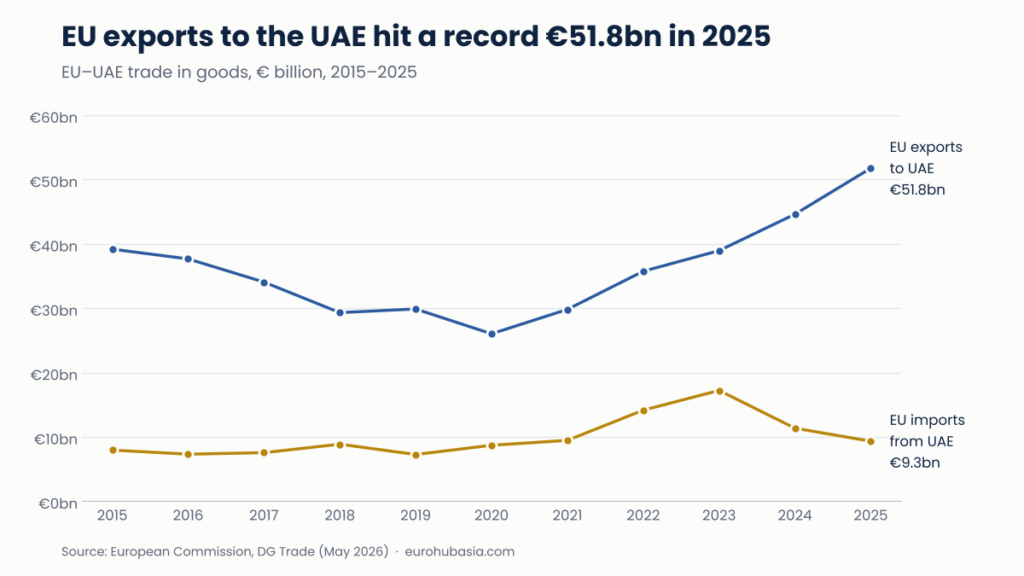
What does Europe sell to the UAE? Mostly high-value goods. In 2025, machinery and appliances made up 29.3% of EU exports to the UAE, transport equipment 19.9% and chemical products 11.8%. If you buy machinery, vehicles, spare parts, chemicals or quality consumer goods, Europe is a natural source.
2. UAE non-oil trade keeps breaking records
The UAE’s non-oil foreign trade passed AED 3.8 trillion (about US$1.03 trillion) in 2025, the first time it has crossed that mark (Khaleej Times). The first half of 2026 brought AED 1.937 trillion, up 13.1% on the same period of 2025 and 78.8% higher than the first half of 2022 (Dubai Media Office).
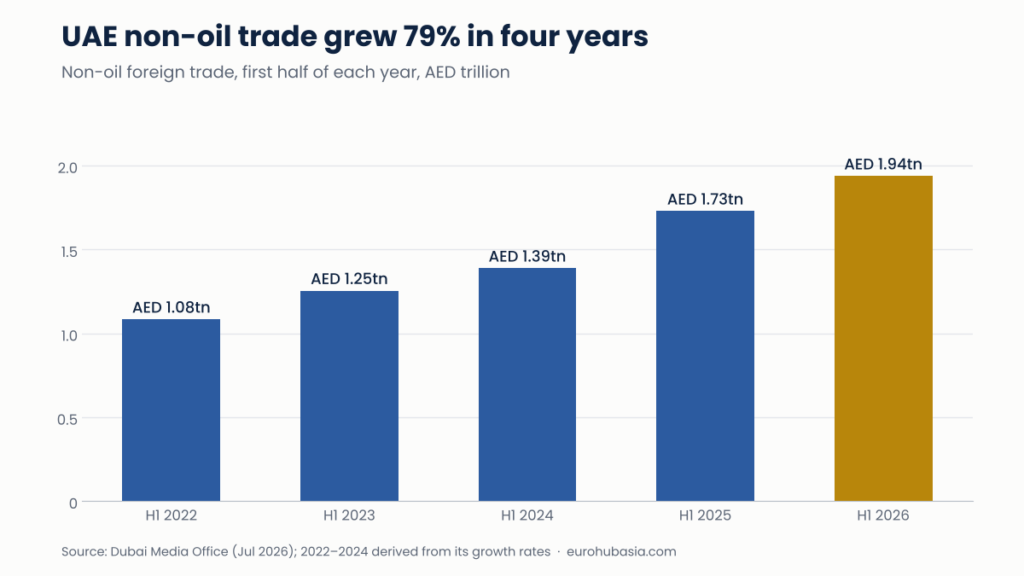
The important point: this growth continued even after the Hormuz disruption began in February 2026. UAE businesses kept trading by finding new routes, which we explain below.
3. Asia is the UAE’s biggest trading region
In the first half of 2026, China was the UAE’s largest non-oil trade partner at AED 180.7 billion, followed by Switzerland (AED 138.4 billion; gold was the UAE’s top traded commodity at AED 706.2 billion) and India (AED 107.5 billion).
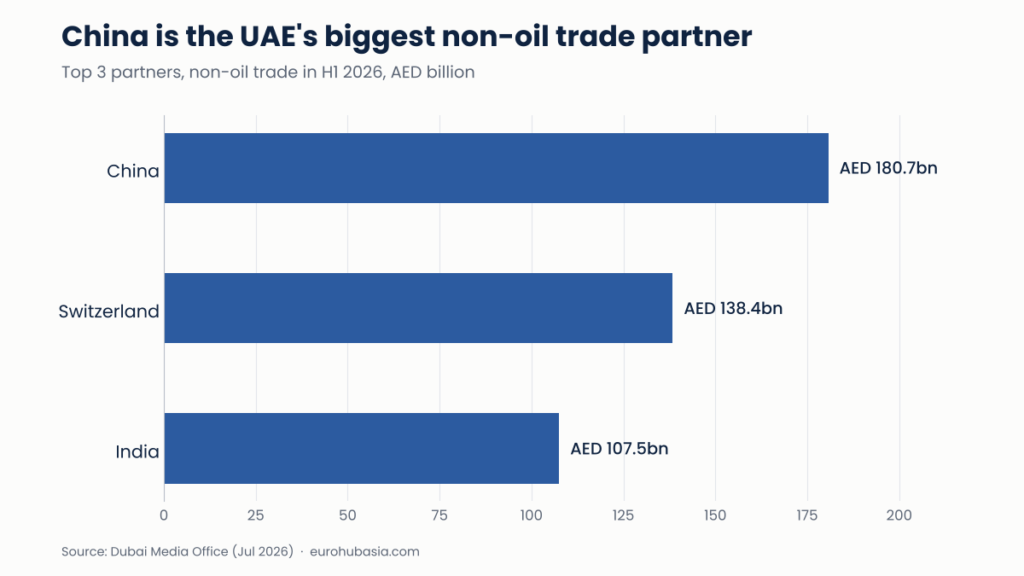
Trade with countries that have a full Comprehensive Economic Partnership Agreement (CEPA) with the UAE reached AED 304.3 billion in the same period. CEPAs lower or remove tariffs and make customs simpler. Before you choose a supplier country, check whether the UAE has a CEPA with it, because it can cut your costs. India is a good example, and our guide to the fastest-growing Asian markets covers more.
What this means for you: Europe is strongest for machinery, vehicles and chemicals. Asia is strongest for volume, price and everyday goods. Most successful UAE buyers use both.
The 2026 shipping reality: Hormuz and the Red Sea
The biggest change for UAE importers in 2026 is the closure of the Strait of Hormuz to normal commercial shipping. If you plan shipments the way you did in 2025, you will likely face delays and surprise costs.
What happened in the Strait of Hormuz
On 28 February 2026, after US and Israeli strikes on Iran, Iran shut the Strait of Hormuz to normal commercial traffic. A short reopening came after a US–Iran agreement in mid-June, but it broke down in early July (Carra Globe). As of 10 October 2026, the strait is still described as effectively closed to commercial shipping, mainly because war-risk insurance makes most voyages impossible. IMF PortWatch counted just 4 ship crossings on 4 October, against a normal level of about 85 a day (straits.live).
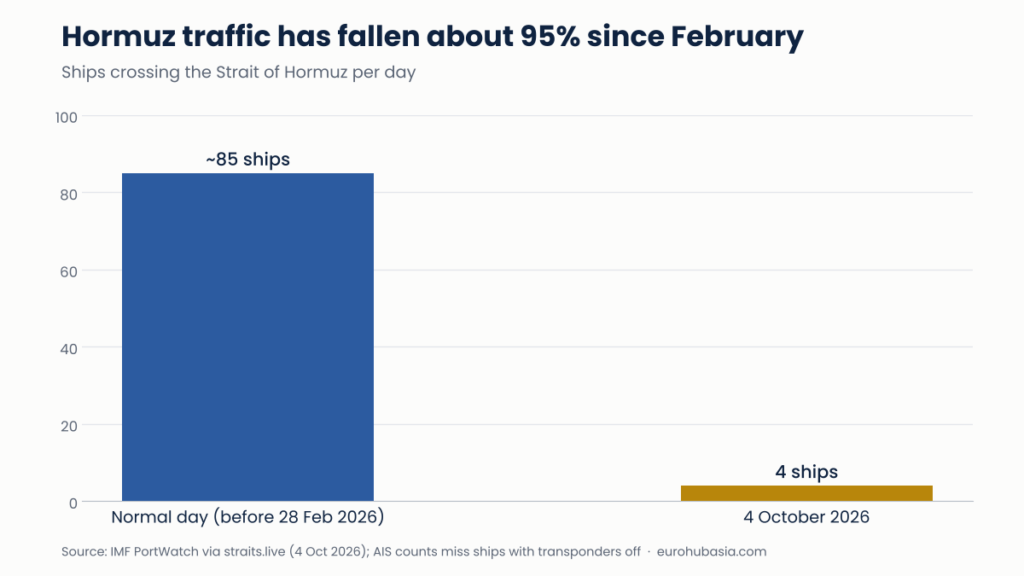
The count is not perfect. Some ships cross with their tracking transponders switched off, so the real number may be a little higher. But the direction is clear: very few ships are sailing through.
What it means for Jebel Ali
Jebel Ali sits inside the Gulf, so ships must pass Hormuz to reach it. Jebel Ali handled about 15.6 million containers (TEU) in 2025. Reports say its container activity fell by around 90–95% after the disruption began, even though the port itself keeps working (Logisticswall). The problem is not cranes or berths. It is that ships cannot safely get there.
The UAE adapted quickly. Cargo is being unloaded at ports outside Hormuz, such as Fujairah and Khor Fakkan on the UAE’s east coast, plus Oman’s ports and Jeddah in Saudi Arabia. From there, it moves by truck or rail to Dubai and Abu Dhabi. DP World also agreed in July 2026 to build two new terminals in Fujairah, on the Gulf of Oman, adding up to 2.5 million TEU of container capacity over the next 24 to 30 months (Enterprise).
The Red Sea and Suez Canal
There is some good news from the west. After years of sailing around Africa to avoid attacks in the Red Sea, the big container lines are coming back to the Suez Canal. By September 2026, CMA CGM, Maersk, MSC, Hapag-Lloyd and COSCO had all returned to varying degrees. Container ship tonnage through the canal in the first eight months of 2026 was 54.2% higher than a year earlier (gCaptain). The route is still risky, and carriers say future use depends on Red Sea stability.
What this means for you
- Expect longer and less predictable transit times. Add a safety margin of one to three weeks to your plans.
- Expect extra costs. Emergency surcharges, war-risk insurance and the final truck or rail leg all add to the price.
- Ask your forwarder about the discharge port. Where your container actually lands now matters as much as where it comes from.
- Check conditions before every booking. The situation changes week by week.
Step 1: Choose your route in 2026
The right route depends on what you are buying, how fast you need it and how much you can spend on freight. In 2026, it also depends on which ports ships can actually reach.
Here are the main options for getting goods from Europe and Asia into the UAE today:
| Route | Best for | Typical transit (approx.) | 2026 notes |
|---|---|---|---|
| Sea to a UAE east-coast port (Fujairah, Khor Fakkan), then truck | Most container cargo | 3–6 weeks from Europe, 2–5 weeks from Asia | Avoids Hormuz; congestion possible at peak times |
| Sea to Oman or Jeddah, then road or rail | Large volumes when UAE ports are busy | Similar to above, plus 2–5 days by land | Extra handling and border paperwork |
| Sea direct to Jebel Ali | Only when Hormuz traffic allows | Uncertain | Very limited while the strait stays closed |
| Air freight | Urgent, light or high-value goods | 1–5 days | Fastest, but capacity is tight and prices are high |
| Sea + air via another hub | Fast but cheaper than full air | 1–2 weeks | Useful for medium-value goods |
Transit times are rough guides only. Always confirm current routes and times with your freight forwarder before you promise dates to your customers.
How to decide
Ask yourself three simple questions:
- How urgent is it? If a delay would cost you a customer, pay for air. If you can wait, go by sea.
- How heavy or bulky is it? Heavy, bulky and low-value goods should almost always go by sea. Air freight on heavy goods can cost more than the goods themselves.
- What is the value per kilo? Electronics, medical items and fashion can often absorb air freight. Building materials, furniture and food packaging usually cannot.
For a full comparison of cost and speed, read our sea or air freight guide.
Why the UAE is still the right hub
Even with Hormuz closed, the UAE remains the best-connected trading base in the region. It has ports on two coasts, large airports, a growing rail network and many free zones where you can store goods and re-export them with simpler customs rules. That is how Dubai became the bridge between European and Asian trade, and it is why UAE trade kept growing through 2026.
Practical tip: ask your forwarder for two quotes on every shipment, one via an east-coast port and one by air or sea-air. Compare the total cost and time, not just the freight rate.
Step 2: Find the right suppliers
Good suppliers are rarely found in one place. The safest approach is to search through at least three channels, build a shortlist of five to ten companies, and then compare them carefully.

Where to look
| Channel | Good for | Watch out for |
|---|---|---|
| B2B marketplaces (Alibaba, Global Sources, IndiaMART, Europages) | Fast search across thousands of suppliers | Trading companies posing as factories |
| Trade fairs in Dubai (Gulfood, Arab Health, Big 5) and abroad (Canton Fair, European industry fairs) | Meeting suppliers face to face and seeing products | Travel time and cost |
| Chambers of commerce and embassy trade offices | Registered, verified local companies | Slower replies |
| LinkedIn and industry associations | Reaching decision makers directly | Takes time to build trust |
| Sourcing partners (like EuroHub Asia) | Pre-checked suppliers and local follow-up | A service fee |
Europe or Asia? A simple way to choose
- Choose Europe when quality, certification and brand reputation matter most: machinery, vehicles and parts, chemicals, medical equipment, premium food and cosmetics.
- Choose Asia when price and volume matter most: packaging, textiles, electronics, household goods, building materials and many industrial parts.
- Mix both when you can. Many UAE buyers use European suppliers for the core product and Asian suppliers for packaging and accessories.
Prepare a clear request (RFQ)
Before you contact anyone, write a one-page Request for Quotation. Suppliers answer clear requests faster, and they quote more accurately. Include:
- Product specification: size, material, colour, quality standard
- Target quantity per order and per year
- Target price, if you have one
- Certificates you need for the UAE (for example Halal, CE, ISO or conformity marks)
- Packaging and labelling requirements, including Arabic labelling if needed
- Your preferred Incoterm and delivery place
- Your deadline
How to compare quotes fairly
Never compare only the unit price. Put every quote into one simple table with the same columns: unit price, Incoterm, minimum order quantity, lead time, payment terms, sample cost and certificates. A supplier that looks 10% cheaper on price can easily be 15% more expensive once freight and terms are included.
If you are exploring new countries, our article on the fastest-growing Asian markets shows where supply and demand are growing quickest.
Step 3: Check them before you trust them
A few hours of checking can save you from losing a whole order. The rule is simple: never send a large payment to a supplier you have not verified.

The 10-point due diligence checklist
- Company registration confirmed – ask for the business licence or a registry extract, and check it on the official registry where possible
- Real address checked – look it up on Google Maps and ask for a live video call walking through the site
- Factory or trader? – ask directly; both can be fine, but you should know who makes the product
- Product certificates valid – check that certificate numbers match the issuing body’s records
- References from other buyers – ideally from the Gulf, and call at least one
- Samples tested – order samples and test them before the main order
- Bank account matches – the account name must match the company name on the contract
- Export experience – ask which GCC countries they already ship to
- Production capacity – make sure they can handle your volume on time
- Sanctions and compliance check – make sure neither the company nor its owners appear on sanctions lists, especially important for routes through sensitive regions in 2026
Red flags: walk away if you see these
- A price far below every other quote
- Pressure to pay 100% upfront, especially for a first order
- Bank details that change by email (a classic fraud sign; always confirm by phone)
- Vague or missing answers about certificates
- No video call, no factory visit, no references
- A brand-new company with no track record offering very large volumes
Use a third-party inspection
For first orders, or any order above a value you could not afford to lose, book an independent inspection company. They can audit the factory before you sign, check production while it runs, and inspect goods before they are loaded. The cost is small compared with a full container of wrong or faulty goods.
Due diligence also covers paperwork. Our trade compliance checklist explains HS codes, certificates of origin and the documents customs will ask for, so you can check them early rather than at the port.
Step 4: Agree on Incoterms (who pays for what)
Incoterms are short three-letter codes, published by the International Chamber of Commerce, that say who pays for transport, insurance and customs, and where the risk passes from seller to buyer. The current version is Incoterms 2020. Always write the term, the place and the version in your contract, for example “FOB Shanghai, Incoterms 2020”.
The five terms UAE buyers use most
| Term | Seller pays up to | Risk passes to you at | Good for UAE buyers when |
|---|---|---|---|
| EXW (Ex Works) | Goods ready at the factory | The factory door | You have your own forwarder in that country |
| FOB (Free On Board) | Loading onto the ship | Goods on board at the origin port | You want to control freight and choose the route |
| CIF (Cost, Insurance, Freight) | Freight and basic insurance to the named UAE port | Goods on board at the origin port | You want one simple price to the port |
| CPT / CIP | Transport (and insurance for CIP) to an agreed place | Handover to the first carrier | Air freight or multi-modal shipments |
| DDP (Delivered Duty Paid) | Everything, including UAE duty and VAT | Delivery at your warehouse | You want no hassle and accept a higher price |
The 2026 twist: name the right place
With Hormuz closed, the “named place” in your Incoterm matters more than ever. A contract that says “CIF Jebel Ali” can cause a dispute if the ship is diverted to Fujairah or Jeddah. Who pays for the extra trucking? Who carries the risk on the extra leg?
To avoid arguments:
- Name a port the carrier can actually reach, such as “CIF Khor Fakkan” or “CIF Fujairah”.
- Or choose FOB or FCA and book the freight yourself, so you control the route.
- Add a clause that says who pays if the vessel is diverted, and who pays war-risk surcharges.
Watch the insurance
Under CIF and CIP, the seller buys insurance, but CIF only requires minimum cover. In 2026, with war-risk premiums at multi-year highs and some insurers restricting cover for Gulf voyages, check exactly what is covered. For valuable cargo, buy your own wider cover.
Simple rule of thumb: if you are new to importing, start with CIF or DDP to an east-coast port. As you grow and find a good forwarder, move to FOB or FCA for better prices and more control.
Step 5: Structure the deal and the payment
A good deal protects both sides. Agree on price, quality, delivery and payment in writing before anything goes into production.

Choose a safe payment method
| Payment method | How it works | Risk for you | Best for |
|---|---|---|---|
| 30% deposit + 70% before shipping (T/T) | Two bank transfers | Medium | Most small and mid-size orders |
| 30% deposit + 70% against copy of Bill of Lading | Balance paid once goods are shipped | Lower | Buyers with some negotiating power |
| Letter of Credit (L/C) | Your bank pays only when documents match the agreed terms | Low | Large orders and new suppliers |
| Escrow or trade assurance | A platform holds the money until delivery | Low | First orders on B2B marketplaces |
| 100% upfront | Full payment before production | High | Avoid, except for small sample orders |
A Letter of Credit costs a bank fee, but it is the safest option for large orders with a new supplier. Your bank pays only when the supplier presents the exact documents you agreed, such as the Bill of Lading, invoice and inspection certificate. Make sure the L/C wording allows for a diverted discharge port in 2026, otherwise a correct shipment can be rejected on a technicality.
Negotiate more than the price
Price is only one lever. You can often get a better deal by negotiating:
- Payment terms – a lower deposit or a longer balance period
- Minimum order quantity – a smaller first order to test the market
- Lead time – faster production in exchange for a firm order
- Packaging and labelling – included at no extra cost
- Spare parts or extra units – a few free units to cover defects
What your contract or purchase order must include
- Product specification, linked to an approved sample
- Quantity, unit price and currency
- Incoterm, named place and “Incoterms 2020”
- Delivery date and a penalty for late delivery
- Payment terms and bank details (confirmed by phone)
- Quality inspection before shipping, and who pays for it
- Packaging and labelling rules for the UAE, including Arabic labels where required
- What happens if goods are faulty or short: replacement, refund or credit
- A clause for route changes, diversions and war-risk surcharges
- Which law applies and how disputes are settled
Keep it simple. A clear two-page purchase order that covers these points is far better than a long contract nobody reads. For large or repeat deals, ask a UAE trade lawyer to review your standard terms once, then reuse them.
Step 6: Clear customs and know your landed cost
The last step is getting your goods through UAE customs and into your warehouse. The core numbers are simple: most imports pay 5% customs duty on the CIF value, plus 5% VAT at entry. Goods from other GCC countries can be duty-free with a valid certificate of origin, and goods held in a free zone may get reduced or no duty until they enter the local market (Middle East Briefing). Import VAT is generally recoverable for VAT-registered businesses.
Documents you will usually need
- Commercial invoice
- Packing list
- Bill of Lading (sea) or Air Waybill (air)
- Certificate of origin
- Product certificates where required (for example Halal for food, conformity marks for regulated goods)
- Your importer code, or a licensed clearing agent acting for you
If your cargo lands at Fujairah, Khor Fakkan or a port outside the UAE, ask your forwarder early how customs will be handled along the way. Extra legs can mean extra documents.
A worked landed cost example
Your landed cost is everything you pay to get the product into your warehouse. Here is a simple example for one container of goods bought FOB in Asia and shipped to a UAE east-coast port. The freight, trucking and clearing figures are for illustration only; use real quotes for your own shipment.
| Cost item | How it is calculated | Amount (AED) |
|---|---|---|
| Goods price (FOB) | US$20,000 × 3.6725 | 73,450 |
| Sea freight + insurance | US$3,000 × 3.6725 | 11,018 |
| CIF value | Goods + freight + insurance | 84,468 |
| Customs duty | 5% of CIF | 4,223 |
| Import VAT | 5% of (CIF + duty) | 4,435 |
| Truck from port to Dubai warehouse | Illustrative quote | 2,500 |
| Clearing agent and port fees | Illustrative quote | 1,000 |
| Total landed cost | 96,625 |
In this example, the goods cost AED 73,450 at the factory, but AED 96,625 to land, about 32% more. Even after you recover the VAT, the real cost is about 25% above the factory price. If you priced your product only on the supplier’s quote, you would lose money.
You don’t need to do this by hand. Use our free landed cost calculator to work out your real cost in a few minutes, before you place the order.
Sustainable packaging and the UAE’s 2026 plastic ban
If your business uses food packaging, cups, cutlery or bags, the UAE’s single-use plastic rules directly affect what you can import. Since 1 January 2026, a UAE-wide ban covers importing, manufacturing and trading these single-use plastic products (The National):
- Beverage cups and lids
- Cutlery: spoons, forks, knives and chopsticks
- Plates
- Straws and stirrers
- Styrofoam food containers and boxes
- Single-use bags thinner than 50 microns, whatever the material
There are some exemptions, including products made for export or re-export, items made from recycled materials within the UAE, medicine and refuse bags, very thin fresh-food wraps and large shopping bags.

What this means for buyers
- Check every packaging order against the list. A container of banned items can be refused at customs.
- Switch to compliant alternatives such as paper, bagasse (sugarcane fibre), bamboo, wood or other approved materials.
- Ask suppliers for proof. Request material specifications and test reports showing the product is not single-use plastic.
- Plan ahead. Demand for compliant packaging has jumped, so lead times from good suppliers can be longer.
Europe or Asia for green packaging?
Both regions have strong suppliers. European producers are often ahead on certification and recycled-content standards, which helps if your customers are hotels, airlines or large retailers with strict sustainability targets. Asian producers, especially in China, India and Southeast Asia, offer large volumes of paper and plant-fibre packaging at competitive prices.
This is one of EuroHub Asia’s core areas. We connect UAE buyers with checked packaging suppliers in both regions, so you can stay compliant without paying too much.
8 common mistakes to avoid
- Choosing on price alone. The cheapest quote often hides poor quality, slow delivery or extra costs later. Compare total landed cost, not unit price.
- Skipping samples. Always test a sample before ordering in bulk, and keep it as the approved reference.
- Unclear Incoterms. “FOB” without a port, or “CIF Jebel Ali” while ships cannot reach Jebel Ali, invites disputes. Always name a reachable place and the Incoterms version.
- Paying 100% upfront. Use a deposit with balance on shipment, a Letter of Credit or escrow instead.
- Ignoring UAE rules. Missing Halal, conformity or origin documents, or banned single-use plastics, can hold goods at the port.
- Forgetting the real cost. Duty, VAT, freight, surcharges and the final truck leg can add 25–35% to the factory price.
- Planning 2025 transit times in 2026. With Hormuz closed, add a safety margin and confirm routes before every booking.
- No written contract. Emails and chat messages are not enough for a large order. Use a clear purchase order covering the ten points in Step 5.
Frequently asked questions
Is the Strait of Hormuz open for shipping to the UAE? As of 10 October 2026, it is described as effectively closed to normal commercial shipping, mainly because of war-risk insurance. Most cargo now reaches the UAE through east-coast ports such as Fujairah and Khor Fakkan, or through Oman and Jeddah, and then travels by road or rail. Check the latest status with your forwarder before every booking.
How long does shipping from Europe or Asia to the UAE take now? By sea, plan for roughly two to six weeks depending on the origin and the discharge port, plus a few days for the land leg. By air, one to five days. These are rough guides; always confirm with your forwarder.
What is the customs duty in the UAE? Most goods pay 5% of the CIF value, plus 5% VAT. Some goods are exempt, GCC-origin goods can be duty-free with a valid certificate of origin, and free zones may offer reduced or no duty.
Which Incoterm is best for a first-time importer? CIF or DDP are the simplest, because the seller handles most of the shipping. In 2026, make sure the named place is a port the ship can actually reach. FOB or FCA gives more control once you have a trusted forwarder.
How do I know a supplier is real? Check the company registration, ask for a live video tour, call buyer references, order samples, and make sure the bank account name matches the company name.
Is a Letter of Credit worth the cost? For large orders or new suppliers, yes. It adds a bank fee but greatly lowers your risk, because the bank pays only against the agreed documents.
Which single-use plastic items are banned in the UAE? Since 1 January 2026, single-use cups and lids, cutlery, plates, straws, stirrers, styrofoam food containers and bags thinner than 50 microns are banned from import, manufacture and trade, with some exemptions.
Need help sourcing from Europe or Asia?
EuroHub Asia connects UAE and Gulf buyers with checked suppliers across Europe and Asia, including sustainable packaging that meets the UAE’s 2026 plastic rules. Tell us what you need, and we will help you find, check and close the right deal, on a route that works in 2026.
Sources
- EU–UAE trade factsheet – European Commission, DG Trade (May 2026)
- UAE non-oil foreign trade H1 2026 – Dubai Media Office (July 2026)
- UAE non-oil trade exceeds AED 3.8 trillion in 2025 – Khaleej Times (January 2026)
- Strait of Hormuz status – straits.live, IMF PortWatch data (October 2026)
- Strait of Hormuz closure 2026 – Carra Globe
- Jebel Ali volume shock – Logisticswall (August 2026)
- DP World Fujairah terminals – Enterprise (July 2026)
- Container shipping returns to Suez – gCaptain (September 2026)
- UAE customs duties and import taxes – Middle East Briefing
- UAE 2026 single-use plastic ban – The National (December 2025)
- Incoterms 2020 rules – International Chamber of Commerce
Get Trade & Logistics Insights in your inbox
Subscribe to our newsletter for the latest updates on Europe-Asia trade, logistics, and business insights